



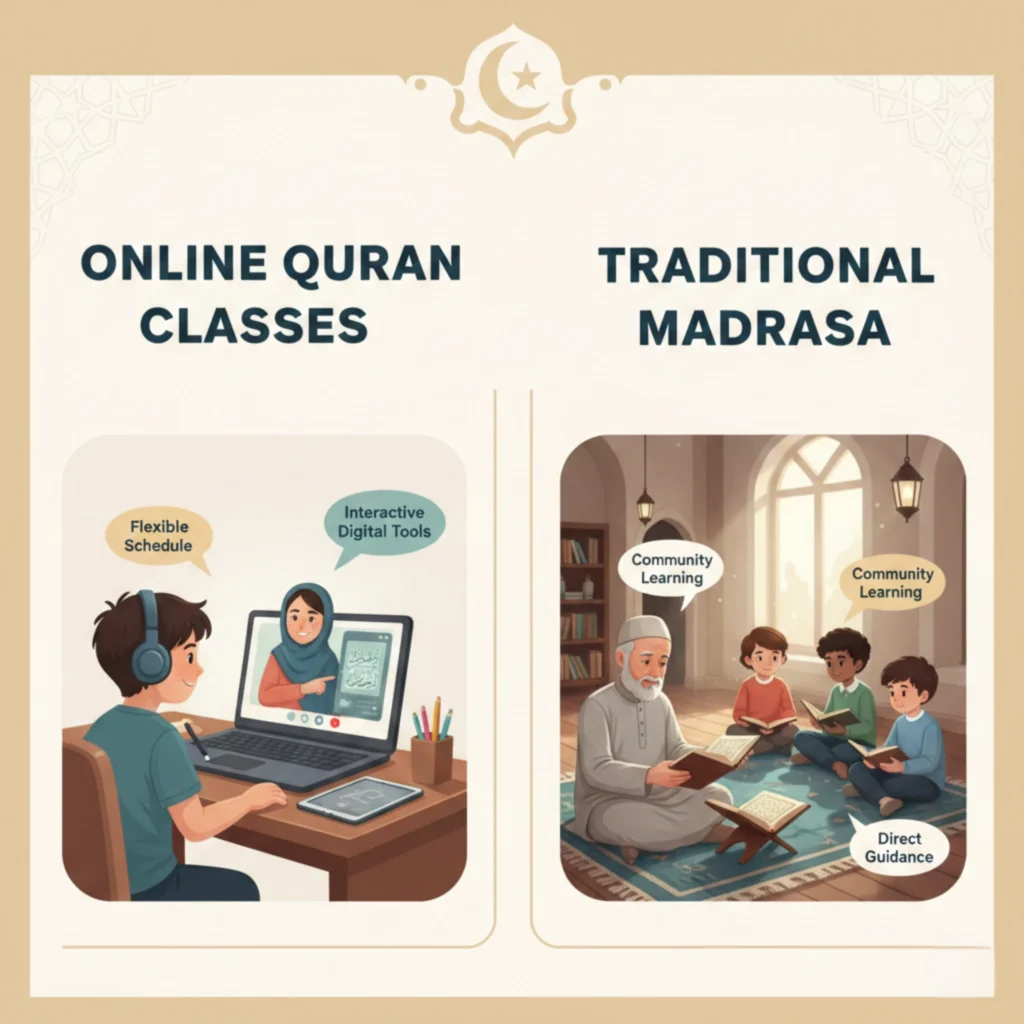
Choosing between online Quran classes vs traditional madrasa is a critical decision for parents. It has an effect on Tajweed accuracy, memorization tendencies and the long term association with Quran. The two forms are similar in terms of establishing a good foundation but they are different in terms of structure, supervision and flexibility.
This is the decision that many parents will have to make, once they realize there are gaps in the learning of their child. Your child, perhaps can not go with the crowd, or it can not go to a madrasa. This guide breaks the differences down into the real world perspective in order to make sure you make the right decisions.
Why Parents Compare These Two Models
The decision usually comes from observation. Parents want consistent progress, correct pronunciation, and a safe learning environment.
Families in the USA, UK, Canada, or Australia may have limited access to structured local madrasas. In Pakistan, quality varies widely between institutions.
Early correction is crucial. Mispronounced letters or weak Tajweed habits in Noorani Qaida can lead to long-term challenges.
Short Case Scenario
Fatima lives in Toronto. Her son, Ahmed at 8 failed to perform in his local madrasa. An environment where more than a group would reference restricted the one on one correction and she was not able to monitor his progress either. After switching to one-to-one online Quran classes, Ahmed began receiving direct feedback on his Tajweed, his recitation improved weekly, and Fatima could monitor every session. This is all that happened, and it helped Ahmed to become more fluent and reduced the anxiety of Fatima.
How Traditional Madrasa Works
Traditional madrasas operate on fixed schedules. Children attend physically in groups, and the teacher manages recitation collectively.
This model fosters discipline and social interaction. Peer observation helps children stay motivated. Islamic surroundings reinforce character development.
However, individual attention is limited. Parents rarely see daily performance, making progress tracking challenging.
How Online Quran Classes Work
Online Quran classes usually provide one-to-one sessions. Teachers correct mistakes instantly and adjust the pace for each student.
Students begin with Noorani Qaida and gradually progress to full Qur’an recitation. Tajweed rules are applied step-by-step. Hifz programs include structured revision ratios and milestones.
Parents can observe sessions directly and receive progress reports. This transparency reduces uncertainty, ensures accountability, and allows children to learn at their own pace.
Direct Comparison
| Criteria | Online Quran Classes | Traditional Madrasa |
|---|---|---|
| Schedule | Flexible | Fixed |
| Attention | One-to-one focus | Group-based |
| Tajweed Correction | Immediate & detailed | Shared attention |
| Parent Visibility | High | Limited |
| Community Exposure | Virtual | Physical |
| Progress Tracking | Structured reports | Informal updates |
Online Quran classes provide flexibility, one-to-one attention, and structured progress tracking. Traditional madrasa offers physical peer interaction and community immersion. Trial sessions help parents understand which environment fits their child’s learning style best.
Structured online programs follow verified curriculum from recognized institutions, such as Islamic Online University – Quran Studies, ensuring Tajweed accuracy and safe Hifz tracking.
Both systems achieve similar goals. The difference is in the delivery and supervision.
Structured Benefits
Benefits of Online Quran Classes
- Focused Tajweed correction
- Flexible timing for parents and students
- Safe, home-based learning environment
- Direct parent visibility
- Customizable Hifz pacing
- Transparent progress reports
Benefits of Traditional Madrasa
- Peer learning and motivation
- Immersive Islamic environment
- Structured daily routine
- Face-to-face mentorship
One-to-one classes allow immediate Tajweed correction, faster mistake identification, and tailored memorization pacing. Structured progress updates give parents visibility and confidence in their child’s learning journey.
Each option aligns differently depending on your child’s personality.
Addressing Parent Fears
Some parents worry online learning weakens discipline. Structure, clear targets, and parental involvement create accountability.

Screen time concerns are valid. Focused recitation sessions differ from passive entertainment. Children actively read and respond.
Another common fear is teacher qualification. Always confirm Tajweed and Hifz credentials. Ask about error correction and curriculum structure.
A trial Quran class before full enrollment helps parents evaluate teaching quality and child engagement.
Real Teaching Insight
In traditional groups, shy students often recite quietly, and subtle Tajweed mistakes go unnoticed.
One-to-one sessions allow immediate feedback. Teachers isolate difficult letters and drill them methodically.
However, socially motivated children may perform better in a madrasa setting. Understanding your child’s learning style is essential.
Common Mistakes Parents Make
- Choosing based on price alone
- Overlooking Tajweed correction depth
- Skipping teacher verification
- Not observing a class before enrollment
- Ignoring progress tracking
Avoiding these mistakes ensures smoother learning outcomes.
Clear Differentiation
Online Quran classes excel in corrective precision and structured tracking. Immediate feedback ensures errors don’t become permanent.
Traditional madrasa builds community, peer motivation, and social engagement. A hybrid approach is possible: children can attend community sessions while refining Tajweed or Hifz online.
The Transformation Parents Want
Visualize your child reciting confidently, pronouncing letters correctly, and completing memorization milestones consistently.
Imagine receiving weekly feedback instead of guessing progress. Structured online systems allow you to plan family schedules without disruption.
This combination of guidance, visibility, and consistency supports both academic and spiritual growth.
Reducing Risk Before Commitment
Start with a trial class. Observe teaching style, correction quality, and child engagement.
Ask about the progression from Noorani Qaida to advanced Tajweed levels. Request clarity on Hifz monitoring and safety protocols.
Small, informed steps reduce uncertainty and build confidence before long-term enrollment.
The Spiritual Reward of Learning the Quran Anywhere
The Prophet ﷺ said:
“The best among you are those who learn the Quran and teach it.” (Sahih al-Bukhari, 5027)
This hadith highlights the importance of learning the Quran, regardless of location. Whether studied at a madrasa, mosque, or online, the reward is equally granted when the Quran is pursued with sincerity.
FAQ’s
Yes. One-to-one sessions provide focused guidance, immediate Tajweed correction, and tailored pace, which often surpasses group settings in ensuring fluency and retention.
It can, for families prioritizing flexibility, supervision, and measurable progress. Some children may still benefit from community interaction, making a hybrid approach effective.
Verify credentials, ask about Ijazah certification, review teaching methodology, and observe a trial class. A structured curriculum and regular progress reports indicate quality instruction.
Structured online Hifz programs with milestone tracking, revision cycles, and one-to-one guidance can match or exceed traditional programs in terms of consistency and corrective precision.
Conclusion
Choosing between online Quran classes vs traditional madrasa depends on your child’s learning style, your family’s schedule, and the level of supervision desired.
If precision, personalized feedback, and visible progress matter, a trial of one-to-one online Quran classes can provide clarity. Observing even a single session gives insight into how your child will grow, recite, and thrive. Small informed steps today set the stage for confident, accurate, and spiritually grounded recitation tomorrow.