



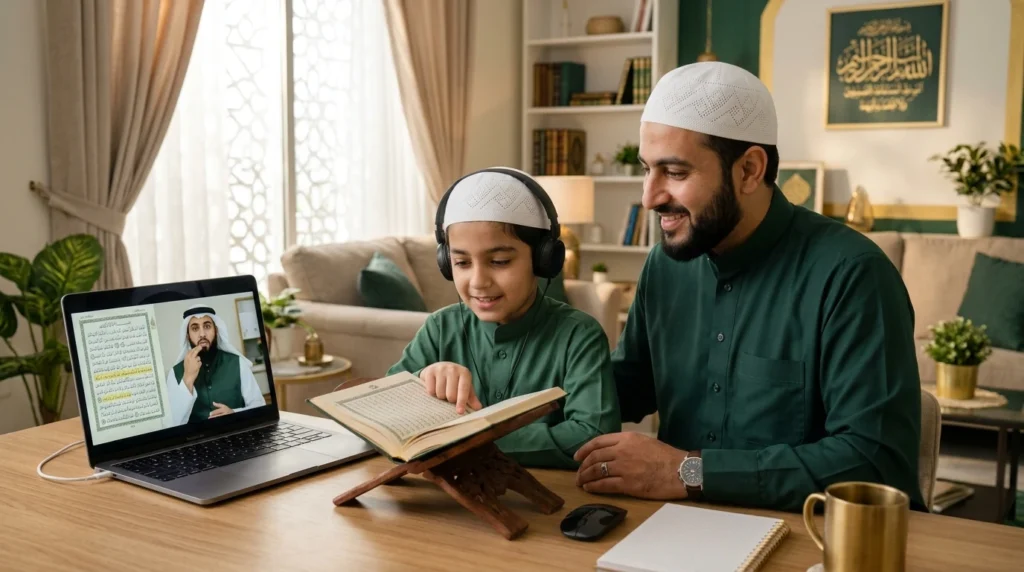
Worried your child is attending Quran classes but still making little progress?
Book a FREE trial class with Al Hamd Islamic Center and receive a personalized Quran assessment from one of our verified Ijazah-certified teachers. You’ll discover your child’s strengths, identify learning gaps, and receive practical guidance-with no obligation or long-term commitment.
What Are Quran Learning Challenges?
Quran learning challenges are the obstacles that slow a student’s progress in recitation, Tajweed, Hifz, or Quran reading. Common causes include weak foundational skills, inconsistent revision, incorrect pronunciation, low motivation, and unstructured teaching. Early assessment and qualified guidance help students overcome these challenges and make steady, confident progress.
Many Muslim parents experience the same concern. Their child attends Quran classes every week, completes assignments, yet still struggles to recite confidently. That worry often grows into a deeper fear: “What if my child learns incorrectly and forms bad habits that become difficult to fix?”
This concern is understandable. The Quran deserves to be recited with care, and children need correct guidance from the beginning. Fortunately, most quran learning challenges have practical solutions. When parents understand the real reasons behind slow progress, they can help their children build strong recitation skills, proper Tajweed, and a lifelong love for the Quran.
Who This Guide Is For
This guide is designed for:
- Muslim parents with children aged 5–12 who are making slower Quran progress than expected.
- Families in the USA, UK, Canada, and Australia seeking structured online Quran education.
- Parents wondering why Quran learning is difficult despite regular classes.
- Families searching for qualified, trustworthy Quran teachers with verified Islamic credentials.
Understanding Quran Learning Challenges
Every child learns differently, but certain patterns appear repeatedly in Quran classrooms. Experienced teachers often identify these patterns long before parents notice them at home.
Understanding the difference between a temporary struggle and a genuine learning obstacle is the first step toward helping your child improve.
What Does Slow Quran Progress Really Mean?
Slow progress does not mean your child lacks ability.
Instead, it means improvement is happening more slowly than expected because one or more learning obstacles remain unresolved.
For example, one child may recognize Arabic letters quickly but struggle with Makhraj. Another may memorize Surahs well yet hesitate while reading unfamiliar verses.
Teachers evaluate progress by looking at consistent improvement rather than comparing one child with another.
Signs Your Child May Be Struggling
Watch for these common signs:
- Reading the same lesson for several weeks.
- Repeating the same Tajweed mistakes.
- Forgetting recently memorized Surahs.
- Mixing similar Arabic letters.
- Losing confidence while reciting aloud.
- Avoiding Quran revision at home.
- Becoming distracted before lessons begin.
One or two of these signs are normal from time to time. However, if several continue for weeks, your child may benefit from a structured Quran assessment.
Why Every Child Learns at a Different Pace
Children do not develop Quran reading skills in the same way.
Some students quickly understand Noorani Qaida but need extra support applying Tajweed rules. Others have excellent pronunciation yet require additional revision to strengthen Hifz.
Experienced teachers adapt their methods instead of expecting every student to follow the same pace.
At Al Hamd Islamic Center, instructors first identify a child’s current ability before introducing new material. This approach prevents unnecessary frustration and helps students build confidence lesson by lesson.
Temporary Difficulty or Long-Term Learning Problem?
Every learner experiences challenging lessons.
A temporary difficulty may disappear after a few practice sessions.
Long-term learning problems usually continue because the root cause has never been addressed.
Teachers commonly observe these underlying issues:
- Skipping Noorani Qaida too quickly.
- Learning from inconsistent teaching methods.
- Memorizing before mastering Tajweed.
- Limited revision between lessons.
- Receiving little personalized feedback.
Identifying these issues early prevents small mistakes from becoming lifelong habits.
7 Reasons Students Stop Making Progress in Quran Learning
Many parents assume slow progress happens because their child lacks focus.
In reality, qualified Quran teachers often find that the problem lies in the learning process rather than the learner.
Here are the most common reasons.
1. A Weak Noorani Qaida Foundation
Noorani Qaida teaches much more than Arabic letters.
It develops correct pronunciation, letter recognition, joining rules, and the foundation for proper Tajweed.
Teachers regularly notice that students who rush through Noorani Qaida often continue making the same Makhraj mistakes months later.
Instead of advancing too quickly, experienced instructors revisit foundational exercises until each sound becomes natural.
That extra time saves months of correction later.
2. Inconsistent Revision at Hom
Children remember what they repeat.
Attending classes twice each week is valuable, but daily revision builds lasting fluency.
Even 15 minutes of focused revision strengthens pronunciation, improves confidence, and helps children retain previously learned Surahs.
One practical method used by many successful families is the “Read–Repeat–Review” routine:
- Read one new lesson.
- Repeat difficult words three to five times.
- Review one previous lesson before finishing.
This simple habit keeps learning balanced and prevents forgotten material from accumulating.
3. Learning From an Unqualified Teacher
One concern deserves serious attention.
“What if my child learns the Quran incorrectly?”
Incorrect pronunciation can become deeply rooted if mistakes remain uncorrected for months.
Qualified teachers listen carefully to every recitation.
They identify pronunciation errors, explain the correct Makhraj, demonstrate the sound, and guide students through repeated practice until accuracy becomes consistent.
At Al Hamd Islamic Center, children learn from more than 200 verified Ijazah-certified teachers with recognized Islamic qualifications.
For example:
- Sadiq ur Rehman is a Dars-e-Nizami graduate from Jamia Faridia Islamabad, specializing in Tajweed through Qirat-e-Sabah, with more than three years of teaching experience.
- Komal Kiani is certified through the Tanzeem ul Madaris Board and has advanced training in Tajweed and Tafseer.
These qualifications help ensure students develop correct Quran recitation from the very beginning.
4. Lack of Individual Attention
No two children make the same mistakes.
Some need additional practice with heavy and light letters.
Others require slower reading exercises before increasing fluency.
Large classes cannot always provide this level of personal attention.
One-to-one instruction allows teachers to:
- Correct mistakes immediately.
- Adjust lesson speed.
- Focus on individual Tajweed weaknesses.
- Build confidence through personal encouragement.
This personalized approach often produces more consistent improvement than a one-size-fits-all classroom.
5. Low Motivation and Confidence
Children enjoy learning when they experience success.
If every lesson feels difficult, motivation naturally decreases.
Experienced teachers know that confidence grows through small, achievable victories.
Examples include:
- Reading one page fluently.
- Correctly pronouncing a challenging Arabic letter.
- Completing one week of consistent revision.
- Memorizing a short Surah with proper Tajweed.
Recognizing these achievements encourages children to continue learning with enthusiasm rather than fear.
6. Busy School and Family Schedules
Families living in the USA, UK, Canada, and Australia often balance school, homework, sports, and family commitments.
Without a realistic Quran routine, learning easily becomes inconsistent.
Teachers usually recommend shorter, regular study sessions instead of occasional long sessions.
A consistent 20-minute daily routine is often more effective than studying only once or twice each week.
Consistency helps children retain what they learn and reduces the need for constant review.
7. No Structured Assessment or Learning Plan
Many students continue attending Quran classes without knowing whether they are improving.
Parents see completed lessons but receive little information about pronunciation, Tajweed, or memorization quality.
At Al Hamd Islamic Center, every student follows the Al Hamd Assessment Framework.
The process includes:
- Initial Quran assessment.
- Personalized learning goals.
- Weekly teacher observations.
- Practical Tajweed correction.
- Regular progress reviews.
- Parent feedback after key milestones.
This structured approach helps students build confidence while allowing parents to clearly understand their child’s development.
Why Is Quran Learning Difficult?
Quran learning becomes difficult when students lack a strong Noorani Qaida foundation, receive inconsistent guidance, skip revision, or develop incorrect Tajweed habits. With qualified teachers, regular assessments, personalized lessons, and supportive parents, children usually overcome these challenges and build confident, accurate Quran recitation.
Common Quran Learning Mistakes Parents and Students Should Avoid
Even dedicated families sometimes make mistakes that slow progress. Fortunately, these habits are easy to correct once parents recognize them.

Expecting Fast Results
Learning the Quran is a journey of steady improvement.
Children who master pronunciation before memorization usually become stronger readers in the long term.
Patience today prevents frustration tomorrow.
Skipping Revision
Revision is not optional.
Experienced Hifz teachers often spend as much time reviewing previous lessons as introducing new memorization.
Without regular revision, students forget what they have already learned and lose confidence.
Prioritizing Memorization Before Correct Recitation
Many parents feel excited when their child memorizes new Surahs.
However, memorizing with incorrect Tajweed often means relearning those verses later.
Correct recitation should always come before speed.
Frequently Changing Teachers
Every teacher has a different teaching style.
Changing instructors too often interrupts progress and makes it harder for children to build consistent learning habits.
A stable relationship with one qualified teacher allows lessons to develop naturally.
Ignoring Tajweed and Makhraj Fundamentals
Some families focus only on completing the Quran quickly.
Experienced educators know that beautiful recitation begins with strong fundamentals.
Children who learn correct Makhraj, Tajweed, and Noorani Qaida early often progress more confidently throughout their Quran learning journey.
Not Sure Why Your Child’s Progress Has Stalled?
A free trial class with Al Hamd Islamic Center includes a personalized assessment by an experienced Ijazah-certified teacher. You’ll receive honest feedback, practical recommendations, and a clear learning plan-with no obligation to continue.
How Parents Can Help Children Overcome Quran Study Problems
Parents do not need to be Quran teachers to make a meaningful difference.
Simple daily habits, encouragement, and regular communication with the teacher often have a greater impact than long study sessions.
The goal is to make learning the Quran a consistent part of family life rather than another task on a busy schedule.
Create a Consistent Learning Routine
Children benefit from predictable routines.
Choose a time when your child is alert and free from distractions. For many families, this is after Fajr, after school, or following Maghrib.
Aim for 15–20 minutes of daily revision instead of occasional long sessions.
A practical routine looks like this:
- Read one new lesson.
- Review one previously learned lesson.
- Practice one Tajweed rule.
- End with positive encouragement.
Teachers often observe that students following this routine retain lessons more effectively and recite with greater confidence.
Encourage Without Creating Pressure
Children should associate the Quran with peace, encouragement, and love.
When mistakes happen, avoid saying, “You keep getting this wrong.”
Instead, guide them with gentle correction.
For example:
- “Let’s read that verse together.”
- “That letter sounds better now.”
- “You’re improving every week, Alhamdulillah.”
Positive encouragement builds confidence and helps children approach the Quran with enthusiasm rather than fear.
Celebrate Small Improvements
Not every success is completing a Juz.
Meaningful progress includes:
- Correcting a difficult Makhraj.
- Reading a full page without hesitation.
- Completing daily revision for one week.
- Applying a Tajweed rule independently.
- Memorizing one Surah with accuracy.
Recognizing these milestones keeps children motivated and reminds them that steady improvement matters more than speed.
Build Quran Into Everyday Life
Children learn best when the Quran becomes part of their daily routine.
Simple ideas include:
- Listening to a skilled Qari during car journeys.
- Revising together after one daily Salah.
- Allowing your child to recite at family gatherings.
- Reviewing one Surah before bedtime.
These habits strengthen confidence without making learning feel overwhelming.
Stay Connected With Your Child’s Teacher
Parents and teachers work best as one team.
Ask practical questions such as:
- Which Tajweed rule needs more attention?
- Which Surah should we revise this week?
- Has pronunciation improved?
- What should we practice at home?
- Is my child ready for the next level?
Regular communication helps identify small issues before they become long-term learning challenges.
What Parents Notice After Following a Structured Learning Plan
Progress often appears gradually.
Many parents first notice changes in their child’s confidence before they notice improvements in fluency.
With consistent guidance, those small improvements continue to build.
Clearer Quran Recitation
Children begin pronouncing Arabic letters more accurately.
As Makhraj improves, hesitation decreases and recitation becomes smoother.
Teachers achieve this through repeated pronunciation drills, guided listening, and immediate correction during live lessons.
Better Tajweed Application
Students no longer memorize Tajweed rules without understanding them.
Instead, they learn to apply rules naturally while reading.
Teachers regularly pause during recitation, explain the relevant rule, model the correct pronunciation, and ask the student to repeat it until it becomes consistent.
Stronger Hifz Retention
Many children memorize quickly but forget just as quickly.
Experienced Hifz instructors solve this by balancing new memorization with structured revision.
A common approach includes:
- New lesson.
- Previous day’s lesson.
- Weekly revision.
- Monthly revision.
This cycle helps students retain what they memorize for much longer.
Greater Confidence During Lessons
Children who once hesitated to read aloud often begin volunteering to recite.
This confidence grows because mistakes are corrected with patience instead of criticism.
When students feel safe asking questions, they become more willing to learn.
A Stronger Connection With the Quran
The greatest transformation is not simply reading faster.
It is developing love and respect for the Quran.
When lessons become enjoyable and achievable, children begin reading willingly instead of only because they are told to.
That positive relationship can remain with them throughout life, In shaa Allah.
Why Qualified Teachers Make the Biggest Difference
Children rarely stop progressing because they lack intelligence.
More often, they stop progressing because no one has identified the real learning obstacle.
Qualified Quran teachers know how to recognize those obstacles early.
Personalized Lessons Replace Guesswork
Every student has different strengths.
One child may need additional Makhraj practice.
Another may require confidence-building before moving to longer Surahs.
Rather than following identical lessons for everyone, experienced teachers adjust pacing, revision, and teaching techniques according to each student’s needs.
Mistakes Are Corrected Before They Become Habits
One of the greatest fears parents express is:
“I don’t want my child to learn the Quran incorrectly.”
That concern deserves careful attention.
Teachers trained in Tajweed listen closely during every lesson.
When they hear an incorrect sound, they:
- Identify the exact pronunciation mistake.
- Demonstrate the correct articulation point.
- Ask the student to repeat the sound several times.
- Reinforce it again during future lessons.
This teaching process prevents incorrect habits from becoming permanent.
Confidence Comes Before Speed
Children should never feel rushed.
Experienced educators know that careful recitation produces stronger long-term results than fast recitation with repeated mistakes.
Once pronunciation becomes accurate, fluency develops naturally.
Teachers Inspire More Than Academic Progress
A qualified teacher does more than complete lessons.
They encourage good manners, patience, respect for the Quran, and consistent learning habits.
These qualities help children build a lifelong relationship with the Book of Allah rather than simply finishing a syllabus.
The Al Hamd Quran Learning System
At Al Hamd Islamic Center, every student follows a structured educational approach called the Al Hamd Quran Learning System.
Instead of moving every child through identical lessons, teachers first understand each student’s current level and then create an individualized pathway for improvement.
This systematic approach helps students build strong foundations before advancing to more challenging stages.
Step 1: Initial Quran Assessment
Every learning journey begins with a comprehensive assessment.
Teachers evaluate:
- Noorani Qaida proficiency.
- Arabic letter recognition.
- Makhraj accuracy.
- Tajweed understanding.
- Quran reading fluency.
- Hifz level, if applicable.
- Student confidence during recitation.
This assessment provides a clear starting point for both teachers and parents.
Step 2: Personalized Learning Plan
Based on the assessment, each student receives an individual learning plan.
Teachers decide:
- Which skills need immediate attention.
- Which Tajweed rules require additional practice.
- How much revision is needed.
- When the student is ready to progress.
This prevents students from moving forward before mastering essential foundations.
Step 3: Weekly Progress Monitoring
Learning improves when progress is measured consistently.
Teachers review:
- Pronunciation improvements.
- Reading fluency.
- Tajweed application.
- Memorization retention.
- Confidence during recitation.
- Homework completion.
Parents receive regular updates so they understand exactly how their child is developing.
Step 4: Guided Revision System
Teachers at Al Hamd understand that revision is essential.
Instead of focusing only on new lessons, students regularly revisit previous material.
A typical revision cycle includes:
- Daily review.
- Weekly consolidation.
- Monthly revision.
- Practical recitation assessment.
This method strengthens long-term retention while reducing forgotten lessons.
Why Parents Trust Al Hamd Islamic Center
Trust begins with qualified teachers, structured education, and transparent communication.
That is why families across the USA, UK, Canada, Australia, and Pakistan choose Al Hamd Islamic Center for online Quran education.
More Than 200 Verified Ijazah-Certified Teachers
Students learn from educators with recognized Islamic qualifications, including:
- Dars-e-Nizami graduates.
- Jamia-trained scholars.
- Certified Hifz instructors.
- Qirat-e-Sabah Tajweed specialists.
- M.A. Islamiat graduates.
- Tanzeem ul Madaris Board certified teachers.
Parents know their children are learning from teachers who have studied the Quran through authentic scholarly chains.
Meet Some of Our Teachers
Sadiq ur Rehman
- Dars-e-Nizami graduate.
- Jamia Faridia Islamabad.
- Qirat-e-Sabah Tajweed specialist.
- More than three years of teaching experience.
He specializes in strengthening pronunciation and correcting Makhraj through patient, step-by-step instruction.
Waseem Abbas
- Scholar from Jamia Darul Tafseer wal Hadees.
- Hifz specialist.
- More than four years of teaching experience.
He helps students balance memorization with structured revision, ensuring stronger long-term retention.
Komal Kiani
- Certified through the Tanzeem ul Madaris Board.
- Tajweed instructor.
- Advanced Tafseer training.
She works especially well with beginners, helping children develop confidence while learning correct recitation.
Sidra Zulfiqar
- Double Master’s degrees in Arabic and Islamic Studies.
- Graduate of Jamia Zia-ul-Uloom.
She combines academic knowledge with practical teaching methods that help students understand both correct recitation and Islamic learning.
Safe, Supervised Learning for Children
Parents deserve complete peace of mind.
Al Hamd Islamic Center provides:
- Professionally supervised online classes.
- Respectful teacher-student communication.
- Flexible scheduling.
- Female Quran teachers for sisters and young learners.
- Regular parent progress updates.
- Continuous quality monitoring.
Every lesson is designed to provide both educational excellence and a safe learning environment where children can grow with confidence and respect for the Quran.
Choosing the Right Quran Learning Program for Long-Term Success
Selecting a Quran academy is an important decision. A good program does more than help a child finish lessons-it builds correct recitation, confidence, and a lifelong connection with the Quran.
Before enrolling your child, look beyond advertising and focus on the quality of teaching.
Questions Every Parent Should Ask
Ask these questions before choosing an academy:
- Are the teachers Ijazah-certified or formally qualified?
- Is every student given an initial Quran assessment?
- Are classes one-to-one or group based?
- How are Tajweed and Makhraj corrected?
- How is progress measured and shared with parents?
- Is there a free trial before enrollment?
Clear answers help parents choose a program based on educational quality rather than promises.
What Makes a High-Quality Quran Learning Program?
A strong online Quran program should include:
- Qualified teachers with verified Islamic credentials.
- A structured curriculum from Noorani Qaida to advanced Quran reading and Hifz.
- Personalized learning plans.
- Regular assessments and progress reports.
- Flexible scheduling for busy families.
- Safe, supervised online classrooms.
- Consistent communication between teachers and parents.
When these elements work together, children learn correctly from the beginning and continue improving with confidence.
Comparison Table: Common Quran Learning Challenges and Their Solutions
| Common Challenge | Root Cause | Practical Solution |
|---|---|---|
| Slow Quran reading | Weak Noorani Qaida foundation | Many students struggle to read the Quran fluently because they never fully mastered the basics of Noorani Qaida. Difficulty recognizing Arabic letters, joining letters correctly, and understanding vowel signs slows reading speed. Revisiting Noorani Qaida and practicing short passages daily builds confidence and improves fluency over time. |
| Incorrect pronunciation | Poor Makhraj and Tajweed habits | Incorrect pronunciation usually develops when students learn without proper guidance. Mispronouncing Arabic letters can change the meaning of Quranic words. A qualified Tajweed teacher provides immediate corrections, teaches the correct articulation points (Makharij), and helps students develop accurate pronunciation through regular practice. |
| Forgetting memorized Surahs | Limited revision | Memorization without consistent revision often leads to forgetting previously learned Surahs. The brain retains information better through repetition. Following a structured revision plan-reviewing daily, weekly, and monthly-helps strengthen long-term memory and keeps memorized portions fresh. |
| Loss of motivation | Unengaging lessons and unrealistic expectations | Students may lose interest if lessons feel repetitive or if they expect rapid progress. Setting small, achievable goals, using interactive teaching methods, and celebrating milestones keeps learners motivated. Positive encouragement from parents and teachers also plays an important role in maintaining enthusiasm. |
| Irregular improvement | Inconsistent attendance and practice | Quran learning requires consistency. Missing classes or practicing only occasionally makes it difficult to build and retain skills. Establishing a fixed study schedule, practicing every day-even for 15–20 minutes-and receiving regular teacher feedback creates steady, measurable improvement over time. |
Practical Parent Checklist
Small, consistent habits often produce the greatest results.
Daily
- Revise for 15–20 minutes.
- Listen carefully to your child’s recitation.
- Practice one Tajweed rule.
- End with encouragement and dua.
Weekly
- Review previously memorized Surahs.
- Ask the teacher about current learning goals.
- Celebrate one improvement.
- Identify one area needing additional practice.
Monthly
- Review your child’s overall progress.
- Discuss assessment results with the teacher.
- Update learning goals where needed.
- Continue strengthening foundational skills before moving ahead.
Frequently Asked Questions
Slow progress usually happens because of weak foundational skills, inconsistent revision, incorrect Tajweed habits, or limited individual attention. A structured assessment by a qualified teacher can identify these issues early and create a personalized learning plan that helps your child improve steadily.
Every child learns differently. Some need extra support with Makhraj, while others require more revision or confidence-building. Patient instruction, consistent practice, and age-appropriate teaching methods help children overcome these challenges and develop strong Quran reading skills over time.
Daily practice is generally the most effective approach. Around 15–20 focused minutes each day, combined with regular live lessons and weekly revision, helps children improve fluency, strengthen Tajweed, and remember previously learned Surahs with greater confidence.
Yes, when they are well structured. One-to-one online classes with qualified teachers allow personalized feedback, flexible scheduling, immediate pronunciation correction, and consistent progress monitoring. These features often make learning more effective for busy Muslim families.
Common mistakes include skipping Noorani Qaida, memorizing before mastering Tajweed, neglecting revision, changing teachers frequently, and rushing through lessons. Correcting these habits early helps children develop accurate recitation and lasting confidence.
Conclusion
Every child faces challenges while learning the Quran, but those challenges do not have to become permanent obstacles. With a strong Noorani Qaida foundation, proper Tajweed instruction, consistent revision, and supportive parents, children can overcome quran learning challenges and develop confident, beautiful recitation.
At Al Hamd Islamic Center, our Al Hamd Quran Learning System combines personalized assessments, structured lesson plans, regular progress reviews, and more than 200 verified Ijazah-certified teachers to help every student learn the Quran correctly and with confidence. Our goal is not only to improve recitation but also to help children build a lifelong love, respect, and understanding of the Quran.