




Is your child trying hard but still struggling to read the Quran confidently? Start with a free one-to-one trial class at Al Hamd Islamic Center. An Ijazah-certified teacher will assess your child’s current level, identify learning gaps, and recommend a personalized plan-with no obligation to continue.
The best way to learn Quran faster is to study consistently with a qualified Tajweed teacher, revise every day, correct mistakes immediately, and follow a structured learning plan. Students who practice for 15–30 minutes daily and receive regular feedback usually progress faster than those who study irregularly without guidance.
Your child started Quran classes with excitement. A few months later, another student is reading confidently while your child still pauses over familiar words. Many Muslim parents in the USA, UK, Canada, and Australia quietly wonder if something is wrong.
The answer is usually reassuring. Most children do not struggle because they lack ability. They struggle because they need better routines, stronger foundations, or more personalized teaching. Understanding how to learn Quran faster is less about rushing through lessons and more about building the right habits from the beginning.
Experienced teachers regularly see children make remarkable progress after small changes in revision, Tajweed practice, and lesson structure. When learning is organized correctly, students develop accurate recitation, greater confidence, and a deeper connection with the words of Allah.
Who This Guide Is For
This guide is written for:
- Muslim parents whose children are learning the Quran online or in person.
- Families worried that slow progress means their child is falling behind.
- Adult beginners who want to improve their Quran reading with confidence.
- Parents searching for qualified teachers who teach with proper Tajweed and patience.
Why Do Some Students Learn Quran Faster Than Others?
Every student follows a different learning journey. Some children recognize Arabic letters quickly, while others need more repetition before they feel confident.
Experienced Quran teachers measure success differently from parents. They look beyond speed and focus on pronunciation, Tajweed accuracy, confidence, and consistent improvement. These qualities build lifelong Quran reading skills.
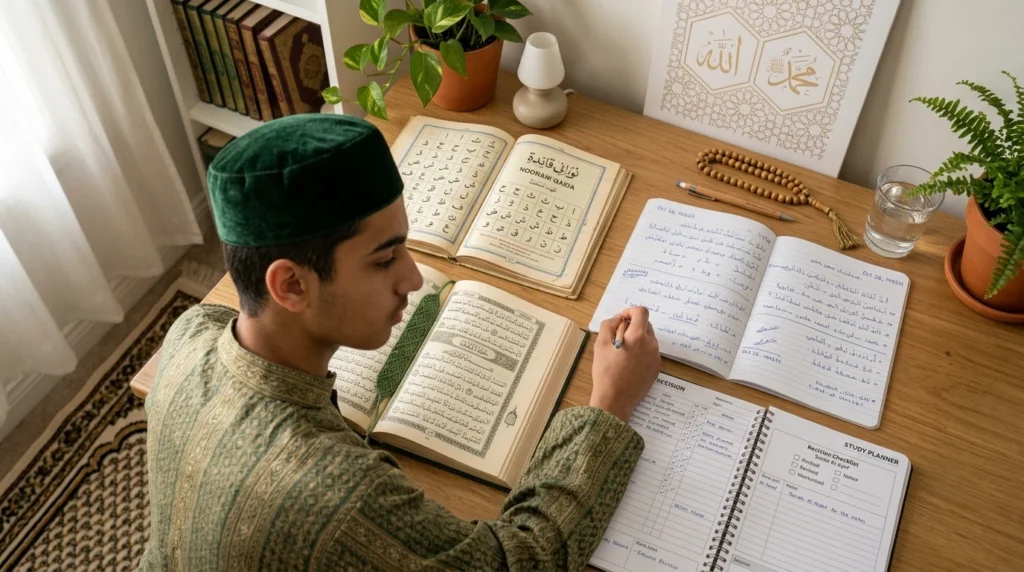
Learning Speed Is Rarely About Intelligence
Parents mostly assume that children who progress quickly are naturally gifted.
Teachers usually observe something different.
Students who attend lessons consistently, revise daily, and welcome correction often improve faster than students with excellent memories but poor routines.
The lesson is simple: good habits usually matter more than natural talent.
Daily Consistency Creates Lasting Progress
Missing lessons or skipping revision interrupts learning.
Many teachers notice that students who miss two or three revision sessions spend much of the next lesson relearning old material instead of moving forward.
By contrast, children who revise for 15 to 20 minutes every day often retain previous lessons more easily and approach new material with greater confidence.
Action Tip
Choose one fixed Quran study time every day. A predictable routine helps children prepare mentally and reduces missed practice.
Confidence Shapes Learning
Some children stop reading aloud because they fear making mistakes.
Patient teachers understand this. Instead of correcting every error at once, they focus on one pronunciation point during each lesson. This approach keeps students motivated while gradually improving accuracy.
Children who feel safe making mistakes usually become more confident readers.
Personalized Teaching Produces Better Results
Every learner has different strengths.
One child may master Noorani Qaida quickly but struggle with fluency. Another may read smoothly yet need extra help with Makhraj.
Personalized lessons allow teachers to adjust the pace instead of expecting every student to learn the same way.
That individual attention often explains why one student progresses much faster than another.
Five Factors That Have the Greatest Impact on Quran Learning Speed
Parents cannot control every part of their child’s learning journey.
However, they can influence the habits that matter most.
1. Consistent Practice
Short daily sessions produce stronger results than occasional long lessons.
A child who studies twenty minutes every day usually remembers more than someone who studies two hours once each week.
Action Tip
Aim for:
- 5 minutes reviewing yesterday’s lesson
- 10 minutes reading new material
- 5 minutes correcting Tajweed
- 5 minutes listening to an experienced reciter
2. Quality Revision
Revision is where real learning happens.
Students who regularly revisit previous lessons:
- remember more verses,
- improve fluency,
- make fewer pronunciation mistakes,
- build stronger confidence.
Without revision, even talented students gradually lose accuracy.
3. Qualified Tajweed Instruction
Many parents worry,
“My child will learn incorrectly and form bad habits.”
This concern is understandable.
Incorrect pronunciation becomes harder to correct when repeated over many months.
Qualified teachers immediately notice problems with:
- Makhraj
- Madd
- Ghunnah
- Qalqalah
- Ikhfa
Early correction prevents these mistakes from becoming permanent habits.
4. A Supportive Home Environment
Parents do not need advanced Islamic qualifications to support Quran learning.
Simple daily habits make a significant difference.
These include:
- creating a quiet study space,
- encouraging regular revision,
- celebrating effort instead of speed,
- asking children to read aloud after class.
For additional parent-focused guidance, you can also read our article on how parenting influences a child’s Quran learning journey, along with educational discussions on student motivation and memorization.
5. Positive Motivation
Children learn better when they enjoy the process.
Pressure and comparison often reduce confidence.
Encouragement produces much better long-term results.
Instead of saying,
“Why isn’t your brother reading this well?”
try saying,
“Your pronunciation has improved since last week. Let’s keep practicing together.”
That simple change encourages steady improvement.
Quran Learning: Good Habits vs. Bad Habits
The difference between slow and steady Quran learning often has less to do with natural ability and more to do with daily habits. Small, consistent actions help students build confidence and retain what they learn, while inconsistent routines can make progress much slower.
| Habits That Improve Quran Learning | Why They Help | Habits That Slow Progress | Why They Slow Learning |
|---|---|---|---|
| Daily revision | Reviewing previous lessons every day strengthens memory and prevents students from forgetting what they’ve learned. | Studying only before lessons | Last-minute practice leads to weak retention and makes each lesson feel like starting over. |
| Reading aloud with correction | Reading aloud allows a teacher or parent to identify and correct Tajweed and pronunciation mistakes immediately. | Silent reading without feedback | Students may repeat pronunciation errors without realizing it, making those mistakes harder to fix later. |
| Mastering Noorani Qaida | A strong foundation in Arabic letters, sounds, and basic Tajweed makes Quran reading smoother and more accurate. | Rushing into Quran reading too early | Skipping the basics often creates confusion and incorrect pronunciation that takes longer to correct. |
| One teacher following one plan | A consistent teacher understands the student’s strengths and weaknesses and can build lessons step by step. | Changing teachers frequently | Different teaching styles and lesson plans can interrupt progress and force students to repeat or skip important concepts. |
| Weekly review sessions | Regular reviews reinforce earlier lessons and help teachers identify areas that need extra attention. | Ignoring previous mistakes | Uncorrected mistakes become habits, making future learning more difficult and slowing overall improvement. |
| Consistent lesson schedule | Studying at the same time each week builds discipline and helps Quran learning become part of a regular routine. | Practicing only when convenient | Irregular study breaks learning momentum, causing students to forget lessons and lose confidence. |
The most successful Quran students are rarely the ones who study for long hours occasionally. Instead, they are the ones who practice consistently, review regularly, and follow a structured learning plan. Even 15–20 minutes of focused daily practice can produce better long-term results than several hours of irregular study. Consistency allows each lesson to build naturally on the previous one, leading to steady improvement in reading accuracy, Tajweed, and confidence.
Parents often ask how to improve Quran learning without adding extra hours.
The answer is usually not more time.
It is better habits.
How to Learn Quran Faster: A Simple 30-Day Improvement Plan
Small improvements repeated every day often produce remarkable progress within one month.
Rather than trying to finish many pages, focus on building a routine your child can maintain.
Week One: Build a Daily Routine
The first week is about consistency.
Use this simple schedule:
- 5 minutes reviewing yesterday’s lesson
- 10 minutes reading new verses
- 5 minutes Tajweed correction
- 5 minutes listening to a qualified reciter
Keep the lesson at the same time every day whenever possible.
Week Two: Strengthen Makhraj
Instead of correcting every pronunciation mistake, concentrate on one or two Arabic sounds each lesson.
Teachers often notice that students improve faster when they master difficult letters individually before combining them into longer passages.
Students who skipped Noorani Qaida frequently return to these exercises because strengthening the foundation improves later fluency.
Week Three: Make Revision Automatic
By now, revision should become part of every lesson.
Many experienced Hifz teachers recommend reviewing previous lessons before introducing new material.
This habit strengthens memory and reduces repeated mistakes.
Ask your child to read yesterday’s lesson confidently before beginning today’s work.
Week Four: Measure Progress Properly
Do not judge success by how many pages your child has completed.
Instead, look for meaningful improvements such as:
- clearer pronunciation,
- stronger Tajweed,
- increased confidence,
- fewer repeated corrections,
- willingness to revise independently.
These signs show lasting growth rather than short-term speed.
Not sure what is slowing your child’s progress?
Every new family at Al Hamd Islamic Center can book a free assessment lesson with an Ijazah-certified teacher. Using the Al Hamd Quran Learning System, we evaluate reading fluency, Tajweed, Makhraj, revision habits, and confidence before recommending a personalized learning path.
Why Qualified Teachers Help Students Learn More Effectively
Parents often focus on how much time their child spends studying. Time matters, but it is only one part of the learning process.
The quality of instruction has an equally important impact on quran learning speed. A knowledgeable teacher helps students build correct habits from the beginning instead of fixing mistakes months later.

Early Correction Prevents Lifelong Mistakes
One of the biggest fears parents share is:
“I’m worried my child will learn the Quran incorrectly and develop bad habits.”
This concern deserves attention.
Teachers regularly see students who learned without proper guidance. Many pronounce similar Arabic letters the same way or miss important Tajweed rules because no one corrected them early.
For example, confusing ق (Qaf) with ك (Kaf) or shortening a required Madd may seem like a small mistake. Repeating it every day turns it into a habit that becomes harder to correct.
Action Tip
Ask your child’s teacher to identify one pronunciation goal each week instead of trying to correct everything in one lesson. Small improvements are easier for children to remember.
Qualified Teachers Hear Mistakes That Technology Misses
Quran apps and recorded recitations are excellent for extra practice, but they cannot evaluate a student’s recitation.
A qualified teacher listens carefully for:
- Incorrect Makhraj
- Missing Ghunnah
- Weak Qalqalah
- Errors in Ikhfa
- Inconsistent application of Tajweed rules
Immediate correction prevents mistakes from becoming permanent.
Technology should support learning, not replace qualified instruction.
One-to-One Lessons Match the Student’s Pace
No two children learn exactly the same way.
Some students need extra practice recognizing Arabic letters. Others understand Tajweed rules quickly but require more reading fluency.
Experienced teachers adjust:
- lesson length,
- revision time,
- correction style,
- homework,
- learning pace.
This personalized approach allows students to progress with confidence instead of feeling rushed.
Accountability Builds Better Study Habits
Students naturally become more consistent when they know someone is monitoring their progress.
Teachers who begin each lesson with a short review quickly identify areas that need extra practice.
Parents also benefit because they receive practical feedback instead of guessing how their child is performing.
Simple weekly updates often include:
- reading fluency,
- pronunciation improvements,
- revision consistency,
- homework completion,
- goals for the following lesson.
How the Al Hamd Quran Learning System Supports Faster Progress
Many Quran academies simply assign lessons and move forward.
Al Hamd Islamic Center follows a structured teaching model called the Al Hamd Quran Learning System. Every stage is designed to strengthen foundations before introducing more advanced skills.
This approach helps students improve steadily without unnecessary pressure.
Step One: Individual Quran Assessment
Every student begins with an assessment.
Teachers evaluate:
- Arabic letter recognition,
- Noorani Qaida level,
- Tajweed understanding,
- reading fluency,
- memorization ability,
- confidence during recitation.
Instead of placing every learner into the same curriculum, teachers build a personalized study plan.
Step Two: Structured Learning Path
Lessons follow a clear sequence.
Students strengthen one skill before moving to the next.
For beginners, that usually means:
- Mastering Noorani Qaida.
- Learning correct Makhraj.
- Applying basic Tajweed.
- Reading fluently.
- Beginning Hifz if appropriate.
This structured approach prevents learning gaps.
Step Three: Continuous Revision
Revision is included in every lesson.
Teachers spend time reviewing previous work before introducing new material.
Experienced instructors often observe that students who revise consistently need fewer corrections over time because good habits become automatic.
Step Four: Regular Parent Communication
Parents should never wonder how their child is progressing.
Teachers provide regular updates so families understand:
- what has improved,
- what still needs attention,
- how to support revision at home,
- which goals are coming next.
This partnership between teacher and parent helps children remain motivated.
Learn From Verified Ijazah-Certified Teachers
Trust matters when choosing someone to teach the words of Allah.
Al Hamd Islamic Center serves families across the USA, UK, Canada, Australia, and Pakistan with a team of more than 200 Ijazah-certified teachers.
Each instructor combines Islamic knowledge with practical classroom experience.
Sadiq ur Rehman
Sadiq ur Rehman is a Dars-e-Nizami graduate from Jamia Faridia Islamabad and specializes in Tajweed with Qirat-e-Sabah certification.
During lessons, he focuses on strengthening Makhraj through gradual correction rather than overwhelming beginners with many rules at once.
Students who struggle with pronunciation often gain confidence through this patient approach.
Waseem Abbas
Waseem Abbas is a scholar from Jamia Darul Tafseer wal Hadees and a dedicated Hifz specialist with more than four years of teaching experience.
He teaches memorization alongside regular revision, helping students retain what they learn instead of simply moving on to new passages.
Komal Kiani
Komal Kiani is certified through the Tanzeem ul Madaris Board and has advanced training in Tajweed and Tafseer.
Her lessons combine careful pronunciation practice with simple explanations that help younger students understand why Tajweed rules matter.
Sidra Zulfiqar
Sidra Zulfiqar holds double Master’s degrees in Arabic and Islamic Studies from Jamia Zia-ul-Uloom.
Her academic background helps students build confidence in both Quran reading and broader Islamic learning.
Safe, Respectful Learning for Every Family
Parents deserve confidence when choosing online Quran classes.
Al Hamd supports children through:
- respectful classroom etiquette,
- child-friendly teaching methods,
- female teachers for sisters and young learners,
- regular parent communication,
- structured lesson supervision.
Learning the Quran should always take place in an environment that encourages respect, patience, and good Islamic manners.
Progress Tracking That Parents Can Understand
Many academies simply say a student is “doing well.”
The Al Hamd system measures progress through clear learning indicators.
Teachers monitor:
- reading fluency,
- Tajweed accuracy,
- Makhraj improvement,
- revision consistency,
- Hifz retention,
- lesson participation.
These benchmarks allow teachers to adjust instruction before small difficulties become larger problems.
Choosing a Quran teacher is an important decision.
A free trial lesson at Al Hamd Islamic Center allows your family to meet an experienced Ijazah-certified teacher, receive a personalized assessment, and see the teaching approach firsthand. There is no obligation to continue, making it a simple, risk-free way to determine whether the learning style is right for your child.
What Parents Commonly Notice After Four to Eight Weeks
Every child progresses differently, but experienced teachers often observe similar improvements when students follow consistent routines.
The changes are usually gradual rather than dramatic.
Clearer Recitation
Children begin pronouncing Arabic letters more accurately because they receive immediate correction during every lesson.
Parents often notice smoother recitation and fewer pauses while reading.
Stronger Tajweed
Students start applying Tajweed rules naturally instead of trying to remember each rule individually.
Regular guided practice turns correct pronunciation into a habit.
Greater Confidence
Many children who once hesitated to read aloud become eager to participate.
Confidence grows because they know mistakes will be corrected kindly rather than criticized.
Better Independent Revision
Students gradually need fewer reminders to practice.
Many begin opening the Quran on their own, reviewing previous lessons, or listening to qualified reciters between classes.
These habits create lifelong learners instead of students who study only for the next lesson.
A Deeper Relationship With the Quran
The greatest transformation is not simply reading more quickly.
It is seeing children recite the Quran with greater care, respect, and love.
When strong foundations, qualified teachers, and consistent practice come together, students develop skills that continue benefiting them for years, in shāʾ Allāh.
Common Mistakes That Slow Quran Progress
Even sincere students can develop habits that make learning more difficult. Fortunately, these mistakes are usually easy to correct once parents and teachers recognize them.
Skipping Daily Revision
Many students enjoy learning new verses but rarely revisit older lessons.
Experienced Hifz teachers often say that revision protects memorization. Without it, students forget previously learned material and begin repeating the same mistakes.
Action Tip
Encourage your child to review yesterday’s lesson before starting anything new. Five to ten minutes of revision each day makes a noticeable difference over time.
Rushing Through Noorani Qaida
Some parents want their children to begin reading the Quran as quickly as possible.
Teachers regularly observe that students who rush through Noorani Qaida often struggle later with Makhraj, fluency, and Tajweed.
A strong foundation always saves time in the future.
Comparing Children
Every child develops at a different pace.
Comparing siblings or classmates often creates anxiety instead of motivation.
Rather than asking why another student is ahead, ask:
- Is my child’s pronunciation improving?
- Is revision becoming more consistent?
- Is confidence growing each week?
These are healthier ways to measure progress.
Changing Teachers Too Frequently
Consistency matters.
When students regularly change teachers, they also change correction styles, lesson routines, and learning expectations.
A stable relationship with one qualified teacher usually leads to stronger long-term improvement.
Depending Only on Apps and Videos
Technology is helpful for listening practice and revision.
However, no application can listen carefully to your child’s recitation and identify subtle pronunciation errors.
A qualified teacher provides immediate correction, encouragement, and accountability that recorded lessons cannot replace.
Ignoring Small Pronunciation Errors
Parents sometimes assume that small mistakes will disappear naturally.
In reality, repeated mistakes become habits.
Correcting pronunciation early prevents students from relearning the same sounds months or even years later.
Can Adults Improve Quran Learning Quickly?
Yes. Adults can improve Quran learning through consistent daily practice, structured revision, and regular feedback from a qualified Tajweed teacher. While children often memorize more quickly, adults usually understand Tajweed rules faster and apply corrections more deliberately, leading to steady and meaningful improvement.
Frequently Asked Questions
Every student learns at a different pace.
Many beginners notice better pronunciation within two or three months of consistent practice. Reading confidently with basic Tajweed commonly takes six to twelve months, depending on lesson frequency, revision quality, and previous experience.
Young children naturally imitate sounds well and often have strong auditory memory.
Adults usually understand explanations more easily and ask better questions. Both groups can succeed when they receive consistent instruction, regular revision, and patient guidance.
Yes.
One-to-one online Quran classes provide immediate correction, flexible scheduling, and personalized teaching. Families often find it easier to maintain regular attendance because lessons fit around school, work, and daily responsibilities.
Most experienced teachers recommend 15 to 25 minutes every day.
Daily practice helps students retain previous lessons, improve pronunciation, and build confidence without becoming tired or overwhelmed.
Choose someone who has:
Verified Islamic qualifications.
Strong Tajweed knowledge.
Experience teaching children.
Patience and excellent communication.
A structured learning system.
Regular progress reporting.
Qualifications such as Ijazah, Dars-e-Nizami, and formal Islamic Studies training provide additional reassurance.
Conclusion
Every student’s journey with the Quran is unique. Some children progress quickly, while others need more repetition, encouragement, and personalized guidance. That difference should never discourage parents or students.
If your goal is to learn Quran faster, focus on the habits that truly matter: consistent revision, proper Tajweed, qualified instruction, and steady encouragement at home. These practices create lasting improvement and help students recite the Quran with confidence, accuracy, and reverence.
At Al Hamd Islamic Center, families benefit from the Al Hamd Quran Learning System, more than 200 Ijazah-certified teachers, structured assessments, and regular parent updates. Whether your child is beginning Noorani Qaida or strengthening Hifz, every lesson is designed to build a lifelong relationship with the Book of Allah.