




Finding the right Quran teacher for your child should not mean committing to a long-term contract before you know whether the classes are a good fit. Many Muslim parents want qualified teachers, consistent Quran learning, and clear monthly fees without worrying about cancellation penalties or unexpected charges.
No contract online Quran classes offer a more flexible way to manage your family’s Quran education. Instead of committing to a lengthy agreement, parents can explore teaching methods, evaluate teacher compatibility, and choose a learning schedule that suits their child’s needs.
At Al Hamd Islamic Center, families can explore live, one-on-one Quran lessons through a three-day free trial before choosing a monthly plan. This gives parents an opportunity to assess the teaching approach and decide whether it meets their expectations.

What Are No-Contract Online Quran Classes?
No-contract online Quran classes are learning programs that do not require students to commit to a fixed long-term agreement. Instead of signing up for six months or a full year, families can choose a monthly learning plan according to their needs and budget.
Depending on the academy’s policies, this arrangement may allow parents to change lesson frequency, request a different teacher, or cancel future lessons without a long-term termination penalty.
For families, the main benefit is flexibility. Parents can evaluate the quality of instruction and their child’s progress before deciding whether to continue.
When comparing online Quran academies, check the details rather than relying on the phrase “no contract” alone. Ask when cancellation takes effect, whether prepaid tuition is refundable, and whether any registration or other mandatory fees apply.
Why Families Prefer Flexible Online Quran Classes
Managing school, homework, extracurricular activities, family commitments, and Islamic education can be challenging. A flexible Quran learning arrangement makes it easier to plan lessons around everyday responsibilities.
Here are several reasons parents consider month-to-month Quran classes.
1. More Control Over Monthly Expenses
Parents often want to understand exactly what they will pay before enrolling their children. A transparent monthly plan makes it easier to budget for Quran education alongside other household expenses.
Before registering, confirm the monthly tuition, number of lessons included, payment schedule, and any additional charges. Clear pricing helps families make informed decisions without unexpected financial commitments.
2. Flexibility Around School and Family Schedules
School examinations, family travel, illness, and changing extracurricular activities can affect a child’s availability.
A flexible academy should explain how schedule changes work, whether missed lessons can be rescheduled, and what happens if a family needs to pause classes temporarily.
Understanding these policies before enrollment helps parents choose a program that fits their circumstances.
3. An Opportunity to Evaluate the Teacher
A teacher’s communication style, patience, pronunciation guidance, and ability to engage a child all influence the learning experience.
A free trial gives parents and students an opportunity to experience a live lesson before selecting a monthly plan. Parents can observe whether the teacher explains concepts clearly, listens to the student, and adapts instruction to the child’s current level.
4. Less Pressure When Starting Online Learning
Families trying online Quran education for the first time may be unsure whether virtual lessons will suit their children.
Starting with a trial and a clearly explained monthly arrangement allows parents to assess the teaching method, class structure, and schedule before making a longer-term decision.
How No-Contract Month-to-Month Quran Classes Work
Before enrolling, understand how registration, tuition, scheduling, and cancellation operate. A transparent process should make these details easy to find.
1. Review Tuition and Any Additional Fees
The monthly price is only one part of the cost. Parents should also check whether the academy charges registration fees, setup fees, or additional amounts for learning materials.
Al Hamd Islamic Center advertises tuition plans for families interested in online Quran education. Review the available packages to compare lesson frequency, class duration, and monthly costs.
You can explore the [Quran tuition fee structure] to identify a suitable plan.
Before completing registration, confirm the total amount payable and whether any additional charges apply to your selected package.
2. Choose a Suitable Lesson Schedule
Students have different learning needs. Some beginners may benefit from shorter, regular sessions, while students working toward Quran memorization may need a more structured weekly schedule.
When selecting a plan, consider your child’s age, current reading ability, school timetable, and learning goals.
Ask the academy how many lessons are included each week, how long each session lasts, and whether schedule adjustments are available.
3. Understand Monthly Billing
Month-to-month enrollment generally allows families to review their learning arrangement at regular billing intervals rather than committing to a lengthy fixed term.
However, monthly billing does not automatically mean that every payment is refundable or that cancellation takes effect immediately.
Before paying, clarify:
- When the monthly invoice is issued.
- Which payment methods and currencies are accepted.
- When a cancellation request must be submitted.
- Whether prepaid tuition is refundable.
- How plan changes affect the next billing cycle.
Clear answers help parents understand their financial commitments before lessons begin.
4. Check the Cancellation and Pause Policy
Families may occasionally need to stop or pause lessons because of travel, illness, examinations, or changes in their circumstances.
Ask whether cancellation requires advance notice, whether a pause is permitted, and whether your child’s usual time slot can be reserved during a break.
Also confirm how any remaining prepaid lessons are handled. Written policies are more reliable than assumptions based on the phrase “cancel anytime.”
5. Ask About Missed Lessons and Rescheduling
Missed lessons can disrupt a student’s routine, particularly when learning Tajweed or memorizing the Quran.
Before enrolling, find out whether make-up classes are offered, how much notice is required, and whether rescheduling depends on teacher availability.
Knowing these details helps families plan around unexpected changes without misunderstanding the academy’s policies.
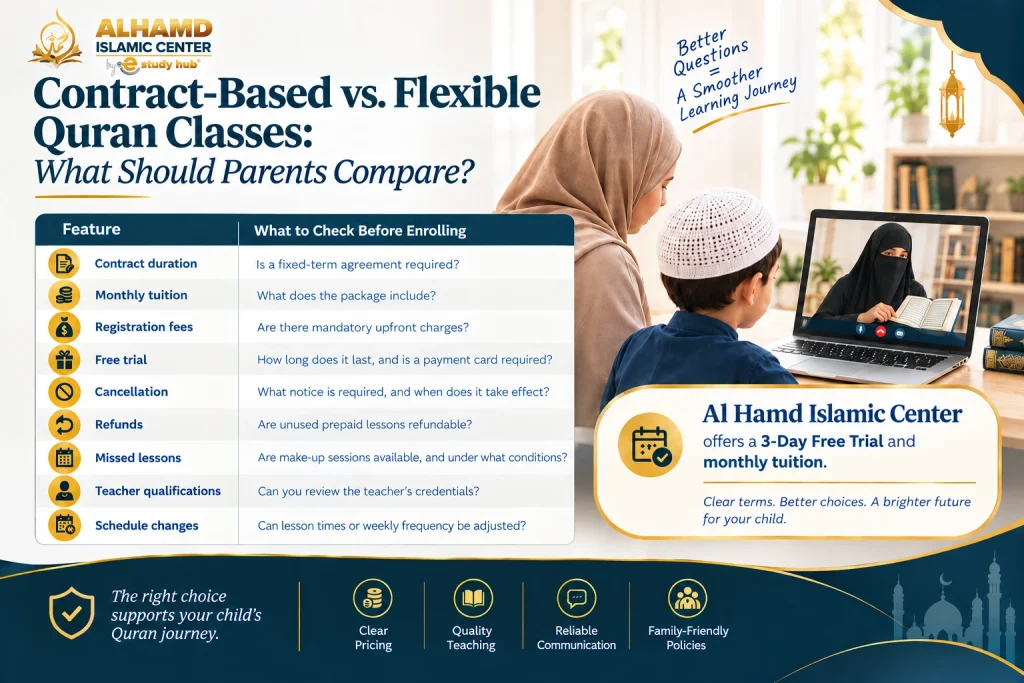
Contract-Based vs. Flexible Quran Classes: What Should Parents Compare?
Not every online Quran academy offers the same enrollment terms. Rather than assuming that all providers follow one billing model, compare their actual policies before making a decision.
| Feature | What to Check Before Enrolling |
|---|---|
| Contract duration | Is a fixed-term agreement required? |
| Monthly tuition | What does the package include? |
| Registration fees | Are there mandatory upfront charges? |
| Free trial | How long does it last, and is a payment card required? |
| Cancellation | What notice is required, and when does cancellation take effect? |
| Refunds | Are unused prepaid lessons refundable? |
| Missed lessons | Are make-up sessions available, and under what conditions? |
| Teacher qualifications | Can you review the teacher’s relevant training and credentials? |
| Schedule changes | Can lesson times or weekly frequency be adjusted? |
Al Hamd Islamic Center offers a three-day free trial and promotes monthly tuition arrangements. Families should review the current enrollment terms to understand the exact conditions that apply to their chosen package.
The best arrangement is one that combines clear pricing, appropriate teaching, reliable communication, and policies your family understands.
Four Red Flags to Avoid When Choosing an Online Quran Academy
Choosing an online Quran academy involves more than comparing prices. Parents should also evaluate teacher qualifications, communication, lesson quality, and enrollment conditions.
1. Unclear Fees and Payment Terms
Be cautious if an academy cannot explain the total monthly cost or provide clear information about additional charges.
Before registering, ask whether tuition includes the scheduled lessons, whether learning materials cost extra, and whether any registration or setup fees apply.
A trustworthy enrollment process should make payment terms understandable before you commit.
2. Unclear Free-Trial Conditions
A free trial is useful when it allows families to evaluate the teaching method before choosing a paid plan.
Check how many trial lessons are included, whether a payment card is required, whether the trial automatically converts into a paid subscription, and what information you must provide to register.
Do not assume that every free trial has the same conditions.
Al Hamd Islamic Center advertises a three-day free trial without requiring a credit card. Confirm the current registration terms when booking.
3. Teacher Qualifications That Cannot Be Verified
Quran recitation requires accurate pronunciation, appropriate Tajweed instruction, and an understanding of the student’s learning level.
Ask about a prospective teacher’s Quran education, relevant certifications, teaching experience, and areas of specialization. For advanced recitation, inquire about the teacher’s specific qualifications and Ijazah where applicable.
You should also evaluate how the teacher corrects mistakes and communicates with your child during a live lesson.
4. Rigid Scheduling and Unclear Rescheduling Rules
Family schedules change. An academy should clearly explain its procedures for changing lesson times, notifying teachers about absences, and requesting make-up sessions.
Ask about advance-notice requirements and any limits on rescheduling. Understanding these rules early can prevent frustration later.
How Flexible Enrollment Supports Consistent Quran Learning
A flexible payment arrangement can make enrollment easier, but flexibility alone does not guarantee educational progress. The quality of instruction, consistency of practice, and suitability of the teaching plan remain essential.
At Al Hamd Islamic Center, the Al Hamd Quran Learning System is designed to provide personalized instruction according to each student’s learning level.
Building a Strong Foundation With Noorani Qaida
Beginners need time to recognize Arabic letters, understand their sounds, and develop accurate pronunciation.
Through structured [Noorani Qaida classes], students can work on letter recognition, articulation, and the foundations needed for Quran reading.
Parents should look for a teacher who corrects pronunciation carefully and checks understanding before moving to more advanced material.
Developing Accurate Recitation Through Tajweed
Once students develop their foundational reading skills, they can work toward more accurate Quran recitation.
In [online Tajweed classes], learners can practise pronunciation, articulation points, and relevant recitation rules with teacher guidance.
Live correction helps students identify mistakes and practise the correct approach during the lesson. Regular revision and appropriate feedback are important parts of developing more consistent recitation.
Following a Structured Quran Memorization Plan
Students interested in memorizing the Quran need a plan that balances new memorization with revision.
An [online Hifz Quran program] may help students organize their learning around their current ability, available study time, and revision requirements.
Parents should ask how progress is monitored, how previous portions are revised, and how the teacher adjusts the workload when a student needs more practice.
Keeping Parents Informed About Progress
Parents benefit from understanding what their children are learning and which areas require additional attention.
Ask the academy how teachers communicate progress, how often feedback is provided, and whether learning goals are reviewed over time.
Clear communication allows parents to support regular practice at home and discuss any concerns with the teacher.
Why Consider Al Hamd Islamic Center for Online Quran Classes?
Al Hamd Islamic Center provides online Quran education for families seeking structured instruction from qualified teachers. Its courses include foundational Quran reading, Tajweed, memorization, and other areas of Islamic learning.
When choosing an academy, parents should consider the following aspects of the learning experience.
1. Teachers With Relevant Islamic Education
Teacher qualifications are an important part of selecting Quran lessons, particularly when students need guidance in pronunciation, Tajweed, or memorization.
Al Hamd Islamic Center identifies the following educators among its teaching team:
- Ustadh Sadiq ur Rehman: Described by the academy as a senior Tajweed instructor with a Dars-e-Nizami qualification from Jamia Faridia Islamabad and specialization in Qirat-e-Sabah.
- Ustadh Waseem Abbas: Identified as a Hifz specialist and graduate of Jamia Darul Tafseer wal Hadees.
- Ustadha Komal Kiani: Described as a Tajweed instructor with certification from the Tanzeem ul Madaris Board.
- Ustadha Sidra Zulfiqar: Described as holding a double master’s qualification in Arabic and Islamic Studies from Jamia Zia-ul-Uloom.
Parents can use teacher profiles and trial lessons to learn more about an instructor’s experience and suitability for their child’s needs.
2. Personalized One-on-One Instruction
Students progress at different rates. A beginner may need additional practice with Arabic letters, while another student may be ready to focus on fluency, Tajweed, or memorization.
Al Hamd Islamic Center offers one-on-one Quran lessons, allowing instruction to focus on the individual student’s current level and learning goals.
Before selecting a package, confirm the lesson format, duration, and weekly frequency. Parents can also discuss their child’s learning needs during the enrollment process.
3. Options for Male and Female Teachers
Some families prefer a male or female Quran teacher for personal, cultural, or family reasons.
Al Hamd Islamic Center states that families can request a male or female instructor. Parents should communicate their preference during registration and confirm availability for their desired lesson times.
A suitable teacher should have relevant qualifications, communicate clearly, and create an appropriate learning environment for the student.
4. Courses for Different Learning Goals
Families may seek Quran lessons for different reasons, from learning Arabic letters to improving recitation or memorizing longer portions of the Quran.
Depending on the student’s needs, relevant options may include:
- Noorani Qaida for beginners.
- Quran reading for students developing fluency.
- Tajweed for accurate recitation.
- Hifz for Quran memorization.
- Tafseer for studying Quranic meanings.
- Islamic Studies and daily supplications.
Parents should select a course according to the student’s current ability and learning objectives rather than choosing a package based only on lesson frequency.
Can You Cancel Online Quran Classes at Any Time?
Whether you can cancel online Quran classes without a penalty depends on the academy’s enrollment and billing policies.
A month-to-month arrangement may allow you to stop future lessons without terminating a long-term agreement. However, you should still check the required notice period, next billing date, refund conditions, and treatment of any prepaid lessons.
Before enrolling at Al Hamd Islamic Center, review the applicable terms and ask student support to clarify anything that is unclear.
Understanding the cancellation policy before making a payment helps you choose a learning arrangement that fits your family’s needs.
Frequently Asked Questions
This depends on the academy’s terms. Al Hamd Islamic Center promotes month-to-month learning without long-term contracts. Confirm the cancellation deadline, any applicable conditions, and whether unused prepaid tuition is refundable before enrolling.
Al Hamd Islamic Center advertises a three-day free trial without requiring a credit card. Check the current registration process to confirm the conditions before booking your trial.
The academy’s published offer should clearly state whether registration, onboarding, and learning materials involve additional charges. Confirm the total amount payable for your selected plan before enrollment.
Missed-lesson arrangements vary between academies. Ask whether make-up sessions are available, how much advance notice is required, and whether rescheduling depends on teacher availability.
Monthly billing generally involves paying according to the selected tuition package and lesson frequency. Before enrolling, confirm the invoice schedule, accepted payment methods, currency, and any additional transaction fees that may apply to your location.
Al Hamd Islamic Center states that families can request a male or female instructor. Share your preference during registration and confirm that an appropriately qualified teacher is available at your preferred time.
Review teacher qualifications, lesson format, monthly tuition, trial conditions, cancellation terms, rescheduling policies, and progress communication. A trial lesson can also help you evaluate whether the teacher’s approach suits your child.
Start Learning Quran Online Without a Long-Term Commitment
Your child’s Quran education deserves a thoughtful choice of teacher, a suitable learning schedule, and clear enrollment terms.
No contract online Quran classes can offer greater flexibility for families who want to evaluate teaching quality and manage their monthly commitments carefully. The important step is to understand the academy’s actual policies and choose a learning plan that supports your child’s needs.
At Al Hamd Islamic Center, you can explore live, one-on-one Quran instruction, discuss your learning goals, and assess the teaching approach through the advertised three-day free trial.
Ready to get started?
- Start Your 3-Day Free Trial
- View Tuition Plans
Choose the next step that helps your family make an informed decision about online Quran learning.
Written by Ustadh Sadiq ur Rehman | Senior Quran & Tajweed Educator | Lead Academic Coordinator
Ustadh Sadiq ur Rehman is described by Al Hamd Islamic Center as a Dars-e-Nizami graduate of Jamia Faridia Islamabad who specializes in Qirat-e-Sabah and Tajweed instruction. The academy’s author biography states that he has more than ten years of teaching experience and serves as Lead Academic Coordinator, overseeing curriculum quality, tutor verification, and student assessment frameworks.