




Learning to recite the Quran with care and clarity is a deeply personal journey. Whether you are practicing in your living room in California. Attending an evening course in London, managing lessons between work and family in New York, or studying in Sydney. The same set of Tajweed rules applies.
This guide explains:
- What Tajweed is and why it matters.
- The essential rules every beginner should start with.
- Practical steps for home practice.
- How to choose the right online Quran classes.
What is Tajweed in Simple Words?
Tajweed is not just a list of technical rules to memorize. It is the art of reciting the Quran as accurately and beautifully as possible, ensuring clarity and preserving meaning.
- Makharij (points of articulation): Teaches where each sound originates (throat, tongue, lips).
- Sifāt (letter qualities): Explains how each sound should be shaped (e.g., heaviness, softness, bounce).
Applying Tajweed ensures that recitation is correct, meaningful, and melodious.
Why Learn Tajweed? (Real Benefits)

- Protects Meaning – A small change in pronunciation can alter the meaning of a word.
- Builds Confidence – Reciting aloud in prayers or study circles becomes easier.
- Improves Memorization – Correct rhythm and sound patterns make memorizing smoother.
- Sharpens Listening Skills – You begin to notice and correct mistakes when following skilled reciters.
Core Building Blocks for Beginners
1. Start Small
- Focus on one simple rule at a time.
- Practice 10–20 minutes daily.
- Seek feedback from a teacher regularly.
2. Makharij (Articulation Points)
Learn sounds from:
- The throat
- The back and tip of the tongue
- The lips
3. Sifāt (Letter Qualities)
- Heaviness (tafkhīm)
- Lightness (tarqīq)
- Bounce (qalqalah)
4. Short Vowels & Madd (Lengthening)
- Short vowels: fatḥah, kasrah, ḍammah
- Madd: extending sounds correctly – too short or too long can change rhythm and meaning.
5. Noon Sākin & Tanwīn Rules
- Idghām (merging)
- Ikhfāʾ (partial concealment)
- Iẓhār (clear pronunciation)
- Iqlāb (conversion)
6. Meem Sākin Rules
Special rules for meem with sukun, including ghunnah (nasalization).
7. Qalqalah (Bouncing Letters)
Learn the letters that “bounce” when pronounced with sukun.
8. Waqf & Ibtidāʾ (Stopping and Starting)
Understand the pause signs in the Mushaf to avoid altering meaning.
A Simple 8-Week Tajweed Practice Plan
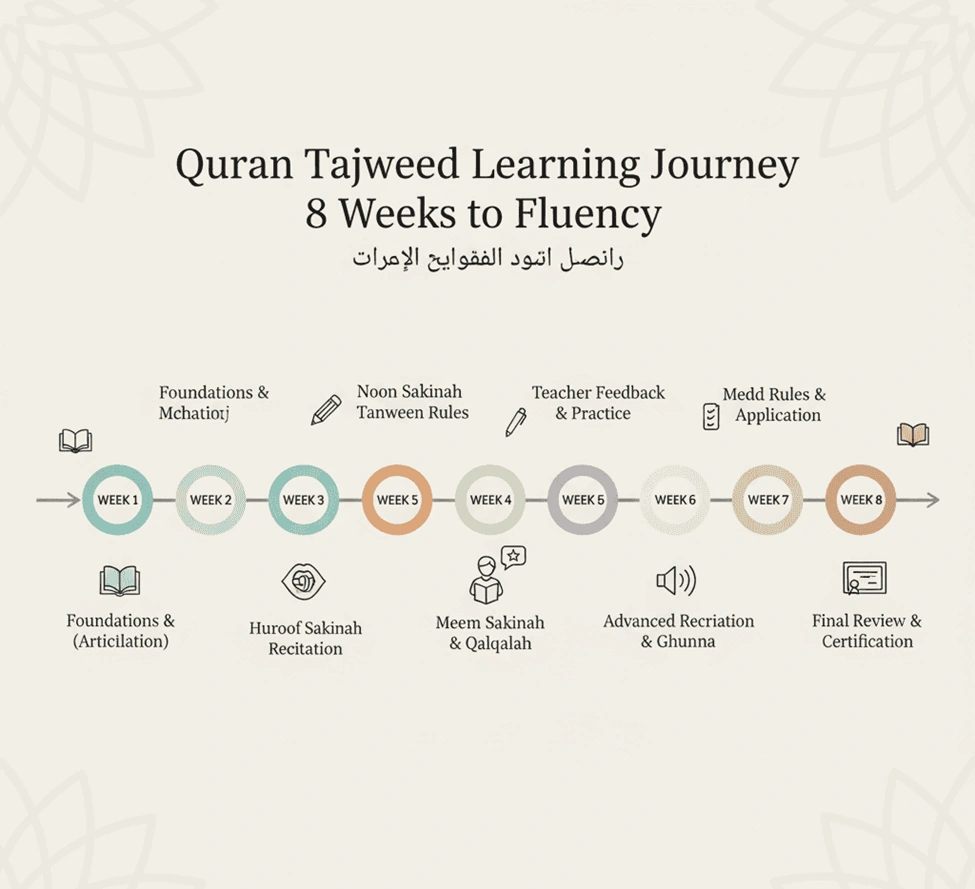
- Weeks 1–2: Makharij practice with a mirror, 5–10 mins daily.
- Weeks 3–4: Introduce sifāt and short vowels; recite short surahs slowly.
- Weeks 5–6: Practice madd rules + noon/meem rules.
- Weeks 7–8: Focus on waqf and fluency; record and review with teacher feedback.
Choosing the Right Online Tajweed Course
If you wish to learn Quran online or join Quran classes online, check for:

- Qualified Teachers: Look for ijāzah or years of teaching experience.
- Live Feedback: One-on-one live sessions > recorded lessons.
- Structured Curriculum: Makharij → Sifāt → Madd → Rules → Waqf.
- Flexible Scheduling: Important for US, UK, Australia, and Pakistan time zones.
- Free Trial: Test a class before committing
Practice Techniques to Build Strong Recitation

- One-ayah focus: Choose one ayah and apply a single rule.
- Record & Compare: Record yourself and compare with a trusted reciter.
- Shadowing: Listen and repeat after a reciter line by line.
- Coloured Mushaf: Use colour-coded Mushaf for easier rule recognition.
- Partner Practice: Read weekly with a friend or small group.
Common Mistakes & Quick Fixes
- Over-stretching Madd: Practice with steady rhythm.
- Mixing articulation points: Slow down and isolate sounds.
- Missed Ghunnah: Drill 2-count nasalization on noon/meem.
- Over-relying on apps: Apps help, but teacher correction is essential.
FAQ’S: Frequently Asked Questions
Yes. Many students in Pakistan, the UK, Australia, and the US learn Tajweed online with qualified tutors.
No. Tajweed focuses on pronunciation and sound, not grammar. Grammar becomes useful later for deeper understanding.
With 10–20 minutes of focused daily practice and weekly feedback, most learners notice improvement within 6–12 weeks.