





Imagine your child has been attending Quran lessons for several months. They can read familiar Surahs, but they keep confusing Arabic letters or repeating the same pronunciation mistakes. You want to help, but you are not sure whether the teacher is correcting them properly.
This is a concern many Muslim parents share. You want your child to learn the Quran correctly, develop good recitation habits, and build a lasting connection with the Book of Allah.
Choosing an ijazah certified quran teacher online can be an important part of that decision. However, Ijazah is only one part of a teacher’s qualifications. Their Tajweed knowledge, teaching experience, and ability to guide children also matter.
This guide explains what Ijazah means, how it is granted, how it differs from Hifz, and how to check a teacher’s credentials before enrolling your child.
Meet a Quran teacher before you decide.Book a free trial class with Al Hamd Islamic Center to discuss your child’s learning level, observe the teaching approach, and ask questions about the teacher’s qualifications.
Who Is This Guide For?
This guide is especially useful if you are:
- A Muslim parent in the USA, UK, Canada, or Australia looking for Quran lessons for a child aged 5–12.
- Concerned about your child’s Arabic pronunciation and Tajweed.
- Considering online Quran classes but unsure how to check a teacher’s qualifications.
- Trying to understand the difference between a Hafiz, a Tajweed teacher, and an Ijazah holder.
Understanding these differences will help you make a more informed choice.
What Is Ijazah in Quran Recitation?
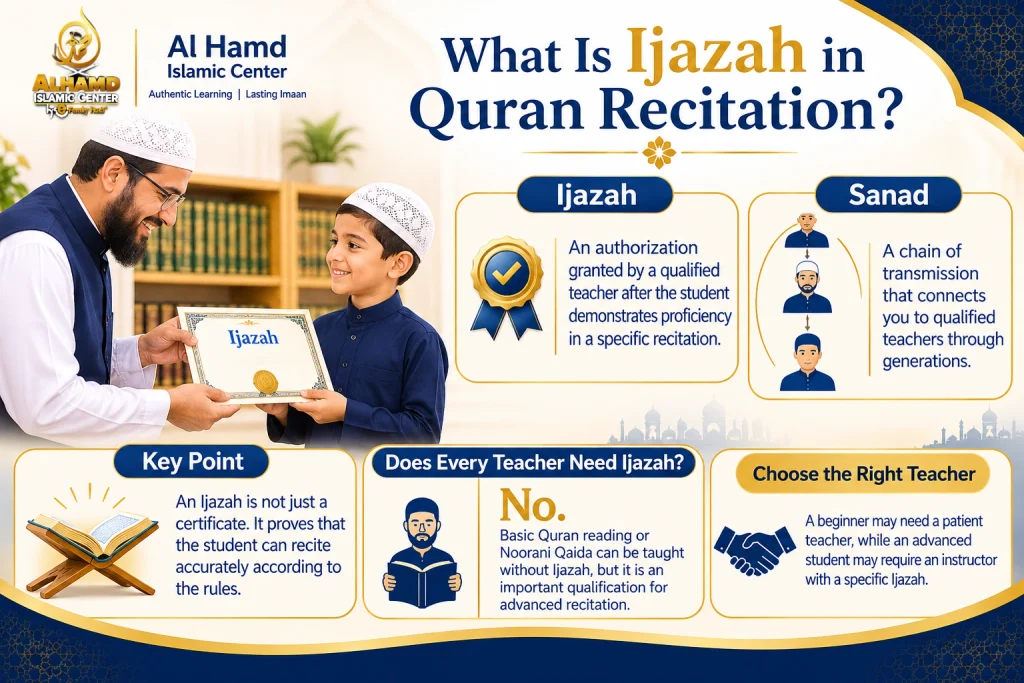
Ijazah in Quran recitation is an authorization granted by a qualified teacher to a student who has demonstrated proficiency in a specific recitation. It is traditionally connected to a Sanad, or chain of transmission, linking the recitation through qualified teachers to earlier generations.
The Arabic word Ijazah means permission or authorization. In Quran recitation, it refers to formal permission granted after a student demonstrates the required standard before a qualified teacher.
It is not simply a certificate for attending a course or completing a set number of lessons. The student must show that they can recite accurately within the requirements of the relevant recitation.
What Is Sanad, and Why Does It Matter?
Sanad means a chain of transmission. In Quran recitation, it connects a reciter to the teachers who taught them before, continuing through a recognized chain of qualified reciters.
Think of it as a teaching connection passed from one generation to another. Each teacher received the recitation from a qualified teacher and continued that transmission through learning and oral instruction.
This tradition helps preserve the accurate transmission of Quran recitation.
An Ijazah is specific to the recitation or area of knowledge covered by the authorization. Parents should ask which Riwayah the teacher’s Ijazah covers rather than assuming all Ijazahs are identical.
Does Every Quran Teacher Need Ijazah?
No. A person can teach basic Quran reading, Noorani Qaida, or introductory Tajweed without holding Ijazah, provided they have suitable knowledge and teaching ability.
However, formal Ijazah is an important qualification when you want to establish whether a teacher has received authorization to transmit a particular Quranic recitation.
The right qualification depends on what your child needs to learn. A beginner may need a patient teacher with strong foundational teaching skills, while an advanced student may need an instructor with a specific Ijazah.
How Does Someone Receive an Ijazah in Quran?
Receiving Ijazah requires more than memorizing the Quran or attending online lessons. The student studies with a qualified teacher and demonstrates the required level of recitation.
The exact process depends on the type of Ijazah and the teacher’s authorization.
1. Build a Strong Foundation in Quran Reading
A student first needs a sound understanding of Arabic letters, pronunciation, and basic reading rules.
For beginners, this often includes Noorani Qaida. It introduces letter recognition, joining letters, vowel sounds, and basic reading patterns.
Students who skip this foundation may struggle with similar-sounding letters and short vowel sounds later. A careful teacher checks these skills before moving the student into more advanced reading.
2. Learn Tajweed and Correct Makhraj
Tajweed teaches the rules that guide proper Quran recitation. Makhraj refers to the articulation point from which an Arabic letter is pronounced.
Some Arabic letters can sound similar to a beginner. A teacher must help the student distinguish them through listening, demonstration, and repetition.
For example, the teacher may ask a child to repeat a difficult letter in isolation, then practise it in a word, and finally read a complete verse containing that sound.
A student may know a Tajweed rule by name but still need practice applying it during recitation.
3. Recite Before a Qualified Teacher
The student reads the required portions of the Quran to their teacher. The teacher listens closely and checks:
- Correct pronunciation of Arabic letters.
- Application of relevant Tajweed rules.
- Proper articulation and letter characteristics.
- Accuracy and consistency throughout the recitation.
- The ability to maintain the required standard.
The teacher corrects mistakes and asks the student to repeat difficult passages. This process may involve repeated readings until the student demonstrates the expected level.
4. Receive Authorization
When the teacher is satisfied that the student meets the required standard, they may grant Ijazah within the scope of their own authorization.
The Ijazah relates to a particular recitation or pathway. It should not be treated as automatic authorization for every Riwayah or Quranic discipline.
This careful process is one reason parents should ask about the specific qualification a teacher holds.
Difference Between Hafiz, Tajweed Teacher, and Ijazah Holder
These three terms relate to Quran learning, but they do not mean the same thing.
A Hafiz has memorized the Quran. A Tajweed teacher has training in the rules of recitation. An Ijazah holder has received formal authorization for a specified recitation or area of knowledge.
| Qualification | What It Means | What It Shows |
|---|---|---|
| Hafiz | Has memorized the Quran | Quran memorization |
| Tajweed-qualified teacher | Has studied the rules of Tajweed | Training in correct recitation |
| Ijazah holder | Has received authorization from a qualified teacher | Authorization within a specified recitation or pathway |
Can One Teacher Hold All Three Qualifications?
Yes. A teacher may be a Hafiz, have advanced Tajweed training, and also hold Ijazah.
However, one qualification does not automatically prove the others.
For example, memorizing the entire Quran is a major achievement, but it does not automatically mean someone has received Ijazah. Similarly, knowing Tajweed rules does not by itself establish a Sanad.
Ask about each qualification separately. This gives you a clearer picture of the teacher’s education and experience.
Why Your Child Needs a Properly Qualified Quran Teacher
One of the biggest fears parents have is simple:
What if my child learns the Quran incorrectly and develops bad habits that are difficult to correct later?
It is a fair concern. Children often repeat what they hear. If a pronunciation mistake goes unnoticed, it can become part of their reading routine.
A good Quran teacher does not simply ask a child to read more pages. They listen, identify mistakes, explain corrections, and give the child enough practice to improve.
Correcting Pronunciation Before Mistakes Become Habits
Consider a child who confuses two Arabic letters because their articulation points differ.
If the teacher only focuses on finishing the lesson, the child may continue making the same mistake. A careful teacher pauses, demonstrates the correct Makhraj, and asks the child to repeat the sound in different words.
The teacher should also check whether the child can use the corrected sound independently during normal reading. This helps prevent a correction from remaining limited to one practice exercise.
Teaching Tajweed Through Practice
Children need more than definitions. They need to hear a rule, see how it works, and practise it during recitation.
For example, when teaching a rule of Noon Sakinah or Tanween, a teacher can:
- Explain the rule in simple language.
- Recite an example aloud.
- Ask the child to identify the rule.
- Let the child read the example.
- Correct the application before moving forward.
This approach helps children understand what they are reading instead of simply memorizing rule names.
Building Confidence and a Positive Relationship With the Quran
A child who receives patient guidance is more likely to feel comfortable asking questions and correcting mistakes.
A good teacher knows when to repeat a lesson, when to introduce a new topic, and when a child needs encouragement.
The aim is not to rush through the Quran. It is to help your child develop accurate, confident, and respectful recitation.
See how a teacher works with your child. Book a free trial class with Al Hamd Islamic Center and observe how the teacher listens, explains, and corrects recitation.
What Is Hafs Ijazah, and Can You Study It Online?
Hafs Ijazah usually refers to authorization in the Riwayah of Hafs ‘an ‘Asim, one of the well-known transmissions of Quran recitation.
The terms Qira’ah and Riwayah describe different levels within the recognized traditions of Quran recitation. Hafs is a Riwayah associated with the recitation of Imam ‘Asim.
Can You Work Toward Hafs Ijazah Online?
Yes. Live online learning can support a student who is working toward Hafs Ijazah.
A live class allows the teacher to listen to the student’s recitation, identify errors, demonstrate corrections, and assign passages for practice.
However, there is an important distinction: attending online Quran lessons does not automatically grant Ijazah.
The student must meet the required standard, and the qualified teacher must assess their recitation before granting authorization.
If you are considering an online pathway, ask:
- Does the teacher hold Ijazah in Hafs ‘an ‘Asim?
- Who granted the teacher’s authorization?
- What level of recitation is expected?
- How does the teacher assess progress?
- What is the process for completing the required recitation?
These questions help you understand whether the program offers general Quran lessons or a structured pathway toward Ijazah.
How to Verify an Ijazah Certified Quran Teacher Online Before Enrolling Your Child
A professional website and a certificate image are not enough on their own. You should feel comfortable asking a teacher about their education and authorization.
Use these seven checks before enrolling your child.
1. Ask for the Teacher’s Full Name and Background
Start with the basics. Ask for the teacher’s full name, Islamic education, and Quran teaching experience.
A qualified teacher should be able to explain where they studied and what they specialize in.
2. Ask Which Scholar or Institution Granted the Ijazah
Ask who granted the Ijazah and where the teacher completed their recitation.
This helps you understand the teacher’s learning background and chain of authorization.
3. Confirm the Specific Riwayah
Do not assume every Ijazah covers the same recitation.
Ask whether the teacher holds Ijazah in Hafs ‘an ‘Asim or another specific Riwayah. The answer should match the course or learning pathway being offered.
4. Ask About the Sanad
A teacher who holds an Ijazah connected to a Sanad should be able to explain the chain and its relevance to their authorization.
You do not need to understand every name in the chain. You should receive a clear explanation of the teacher’s authorization and the recitation it covers.
5. Request Supporting Documentation
Ask whether the teacher can share appropriate evidence of their qualification.
This may include an Ijazah document or details of the issuing teacher. A certificate should identify the relevant authorization rather than make broad claims without explanation.
6. Confirm the Details Where Possible
If the teacher names a scholar or institution, ask whether the details can be confirmed with that source.
Not every traditional authorization has a public online verification system. Still, a teacher should be willing to answer reasonable questions about their background.
7. Observe a Live Recitation and Teaching Session
This is especially important when choosing a teacher for your child.
During a trial lesson, observe whether the teacher:
- Recites clearly and accurately.
- Corrects mistakes with patience.
- Explains pronunciation in a way your child understands.
- Gives your child time to practise.
- Maintains a respectful and encouraging manner.
A strong qualification matters, but the ability to teach children matters too.
Questions You Can Ask Before Enrolling
Use these questions during your first conversation with an academy:
- What Quranic qualifications does the teacher hold?
- Does the teacher have Ijazah? If so, in which Riwayah?
- Who granted the Ijazah?
- How do you assess a child’s current reading level?
- How do you track Tajweed and pronunciation progress?
- Will parents receive regular updates?
Clear answers help you make a confident decision.
Common Mistakes Parents Should Avoid When Choosing an Online Quran Teacher
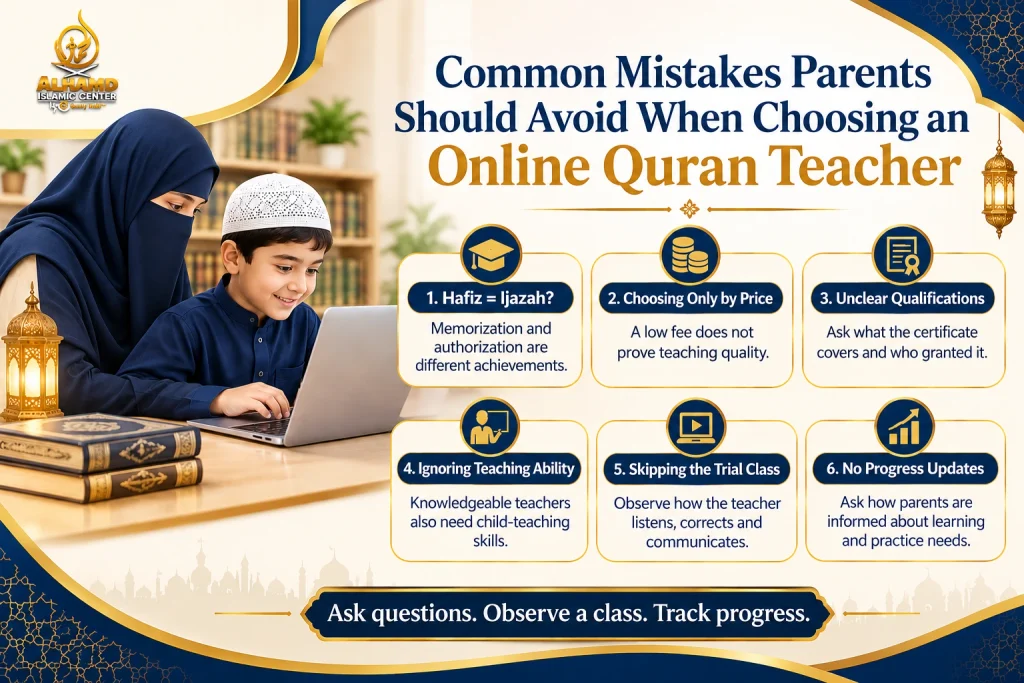
Even with good intentions, parents can overlook important details when comparing Quran academies.
Avoid these common mistakes:
- Assuming every Hafiz holds Ijazah: Memorization and authorization are different achievements.
- Choosing only by price: A low fee does not tell you whether a teacher can correct recitation properly.
- Accepting unclear qualification claims: Ask what a certificate covers and who granted it.
- Ignoring teaching ability: A knowledgeable teacher also needs the skills to teach young children.
- Skipping the trial class: Observe how the teacher listens, corrects, and communicates.
- Not asking about progress updates: Parents should know what their child has learned and what needs more practice.
A little care at the beginning can help you avoid problems later.
What Parents Notice After Starting Quran Lessons With a Qualified Teacher
Progress looks different for every child. Some children recognize Arabic letters quickly but need more time to pronounce them correctly. Others read fluently but need focused Tajweed practice.
With consistent lessons and suitable guidance, parents may begin to notice several changes.
More Accurate Pronunciation
The child starts paying attention to Makhraj and the sounds of individual letters. Instead of rushing through a line, they learn to pause and correct difficult words.
Better Understanding of Tajweed
The child begins to recognize familiar Tajweed rules during recitation and apply them with greater consistency.
Greater Confidence
A child who understands their mistakes and knows how to correct them may feel more comfortable reading aloud.
A Clear Learning Routine
Regular lessons, revision, and parent updates help families understand what comes next.
Over time, the goal is a child who reads more carefully, applies learned rules, and approaches Quran recitation with confidence and respect. Progress depends on the child’s starting level, attendance, practice, and the teacher’s guidance.
Learn Quran With Qualified Teachers at Al Hamd Islamic Center
Choosing an academy means choosing a learning environment for your child. You need teachers with suitable qualifications, a clear curriculum, and a teaching approach that respects each child’s pace.
At Hamd Islamic Center provides online Quran education for families in the USA, UK, Canada, Australia, and other regions.
The academy reports that its teaching team includes more than 200 Ijazah-certified teachers. Parents can ask for details about their assigned teacher, their qualifications, and the recitation covered by their authorization.
Meet Some of the Academy’s Teachers
The academy’s teaching team includes educators with different areas of Islamic study and Quran teaching experience.
Ustadh Sadiq ur Rehman
- Dars-e-Nizami education from Jamia Faridia, Islamabad.
- Tajweed and Qirat-e-Sab’ah specialization.
- More than three years of teaching experience.
His background includes formal Islamic studies and specialized Quran recitation training.
Ustadh Waseem Abbas
- Scholar trained at Jamia Darul Tafseer wal Hadees.
- Hifz qualification.
- More than four years of teaching experience.
His background combines Quran memorization and Islamic scholarship.
Ustadha Komal Kiani
- Tajweed training.
- Tanzeem ul Madaris Board qualification.
- Tafseer training.
Her studies include Quran recitation and the understanding of Quranic meanings.
Ustadha Sidra Zulfiqar
- Double Master’s degrees in Arabic and Islamic Studies.
- Education from Jamia Zia-ul-Uloom.
Her academic background includes Arabic and Islamic Studies.
These profiles represent different areas of expertise. When you book a class, ask which teacher best matches your child’s age, level, and learning goals. You can also ask about the specific Ijazah held by the teacher assigned to your child.
The Al Hamd Quran Learning System
Children do not all begin at the same level. A five-year-old who is learning Arabic letters needs a different approach from a ten-year-old who already reads the Quran.
The Al Hamd Quran Learning System focuses on understanding the student’s current ability and building a suitable learning plan.
The process can include:
- Initial assessment: The teacher checks letter recognition, reading fluency, pronunciation, and existing Tajweed knowledge.
- Personalized lesson plan: The teacher selects suitable lessons based on the child’s needs.
- Live recitation practice: The child reads while the teacher listens and corrects mistakes.
- Revision: Previously learned material is reviewed to strengthen retention.
- Progress evaluation: The teacher reviews improvement and identifies areas that need more work.
For a beginner, the learning path may start with Noorani Qaida. A more advanced student may focus on Quran reading, Tajweed, or Hifz.
The academy also offers learning in areas such as Tafseer, Islamic Studies, and daily supplications.
Parent Communication and Monitored Lessons
Parents should not have to guess how their child is progressing.
A structured learning arrangement should make it possible to understand what the child covered, which mistakes the teacher corrected, and what needs more practice.
Al Hamd describes its approach as including monitored classes and regular parent communication. During your initial conversation, ask how lesson monitoring works and how often you will receive progress updates.
You can use the free trial class to observe the teacher’s communication, recitation, and interaction with your child. It is also a chance to ask about lesson scheduling, progress updates, and the teacher’s qualifications.
Start With a Free Trial Class
You do not need to make a long-term decision before seeing how a lesson works.
A free trial gives you an opportunity to:
- Meet the teacher.
- Discuss your child’s Quran learning level.
- Observe how the teacher corrects recitation.
- Ask about qualifications and teaching methods.
- See whether your child feels comfortable.
There is no need to commit before you have had the chance to assess the teaching approach.
Give your child a chance to learn with patient Quran educators. Book a free trial class with Al Hamd Islamic Center and see the teaching approach for yourself.
Frequently Asked Questions
Ijazah is an authorization granted by a qualified teacher to a student who has demonstrated the required proficiency in a specific Quranic recitation or area of knowledge. In Quran recitation, it is traditionally connected to a Sanad, or chain of transmission, linking the teacher to earlier qualified reciters.
Yes. A person can teach basic Quran reading, Noorani Qaida, or Tajweed without holding Ijazah if they have suitable knowledge and teaching skills. However, teaching basic Quran reading and holding formal authorization to transmit a specific recitation are different responsibilities.
A Hafiz is someone who has memorized the entire Quran. An Ijazah holder has received authorization from a qualified teacher in a specified recitation or field. A person can hold both qualifications, but memorization alone does not automatically grant Ijazah.
You can study toward Hafs Ijazah through live online lessons with a qualified teacher. The teacher listens to your recitation, corrects mistakes, and assesses your progress. However, attending online classes alone does not grant Ijazah. You must meet the required standard and receive authorization from the qualified teacher.
Ask for the teacher’s full name, educational background, Ijazah details, issuing scholar, and the specific Riwayah covered. Request supporting documentation and seek confirmation from the issuing authority where possible. You should also observe a live lesson to assess the teacher’s recitation and teaching skills.
An Ijazah can provide evidence that a teacher has received authorization in a specific Quranic recitation. This is valuable when you want to understand the teacher’s transmission background. You should also check their Tajweed knowledge, ability to correct pronunciation, experience with children, and teaching approach
Choose the Right Quran Teacher for Your Child
Your child’s Quran education deserves careful attention. A teacher should have the knowledge to guide recitation and the patience to help a young learner improve step by step.
Understanding Ijazah helps you ask better questions. It also helps you distinguish between memorization, Tajweed training, and formal authorization.
When comparing online Quran academies, look beyond a certificate or promotional claim. Ask about the teacher’s qualifications, listen to their recitation, and observe how they correct your child’s mistakes.
If you are considering Al Hamd Islamic Center, begin with a free trial class. Meet the teacher, discuss your child’s needs, and see whether the learning approach feels right for your family.
Choosing an ijazah certified quran teacher online should be about more than finding a convenient class. It should be about giving your child careful guidance as they learn to recite the Quran correctly and confidently.
Book your free trial class with Al Hamd Islamic Center. Take the first step toward a structured and supportive Quran learning experience for your child.
Written by Ustadh Sadiq ur Rehman
Tajweed Specialist | Dars-e-Nizami, Jamia Faridia Islamabad | Qirat-e-Sab’ah Specialization | 3+ Years of Teaching Experience
Ustadh Sadiq ur Rehman is a Quran educator with a background in Dars-e-Nizami studies from Jamia Faridia, Islamabad, and specialization in Tajweed and Qirat-e-Sab’ah. With more than three years of teaching experience, he helps students improve their Quran recitation through structured instruction, careful listening, and practical correction.