




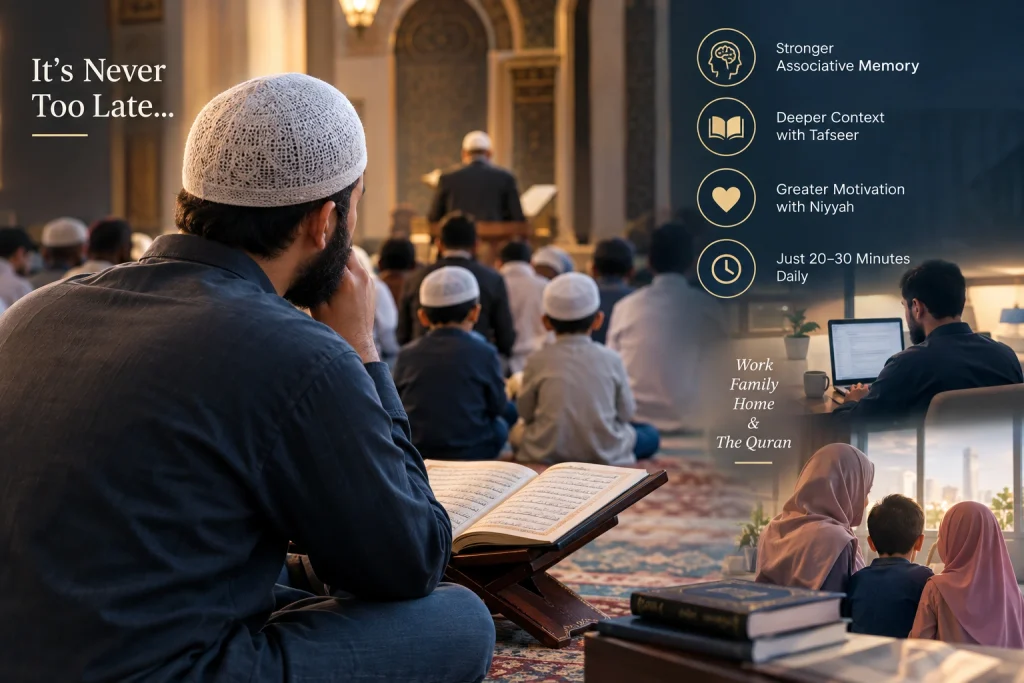
It is never too late for an adult to start Hifz. While children rely on rote mechanical memory, adults excel through cognitive abilities like associative memory, contextual understanding (Tafseer), and intentional motivation (Niyyah). With a structured daily commitment of 20 to 30 minutes, working professionals can successfully memorize the Quran at a steady pace.
You sit in the masjid during Taraweeh late at night. The Imam recites fluently from memory, his voice echoing through the hall. Beside you, young children follow along without opening a Mushaf.
A quiet thought enters your mind: “Did I miss my window?”
Balancing a demanding 9-to-5 job, raising children, and managing household duties in the USA, UK, or Canada makes Quran memorization feel out of reach. Many adults worry their memory is too weak or that learning incorrectly will cause them to form bad recitation habits.
Age is not an obstacle in the sight of Allah. In fact, starting as an adult gives you distinct intellectual and spiritual strengths that young children do not have. With the Al Hamd Quran Learning System, you can carry the Quran in your heart regardless of your age.
Who This Guide Is For
- Busy Working Professionals: Corporate employees, healthcare workers, and business owners who need a micro-learning routine that fits around long shifts.
- Dedicated Muslim Parents: Fathers and mothers who want to lead home prayers with confidence and set an inspiring example of Quranic devotion for their household.
- Reverts & Adult Beginners: Individuals who learned Arabic reading later in life and want a structured path toward quran memorization for beginners.
- Sisters Seeking Private Instruction: Muslim women seeking female-led, flexible, and fully private 1-on-1 Hifz learning environments.
The Adult Memory Advantage: Why Starting Hifz After 20, 30, or 40 Is a Strength
Children memorize through auditory repetition. They absorb sound quickly, but they often struggle to understand structural connections.
Adult brains process information differently. Adults use semantic memory—the ability to connect new information to existing concepts, meanings, and visual patterns.
When an adult memorizes a verse, they do not just memorize the sound of the words. They understand the background of the verse, the emotional weight of the divine message, and the underlying Arabic grammar. This contextual understanding (Tafseer) serves as a strong mental anchor.
Rote Learning vs. Comprehension-Based Retention
Attempting to force your brain into pure mechanical repetition like a child often leads to frustration. Adults retain information far better when they combine visual reading with conceptual understanding.
Before starting memorization, ensure your foundation in Arabic letter articulation is solid. Studying proper online Tajweed classes allows you to recognize rules instantly, freeing up your cognitive energy to focus purely on retention rather than struggling with basic pronunciation.
When you understand the meaning of the passage you are memorizing, one verse naturally flows into the next. If your memory wavers on a word, the context of the sentence helps your mind retrieve the correct phrase naturally.
The 3-Tier Daily Hifz Routine: Demystifying Sabaq, Sabaq Para, and Manzil
Traditional madrasas across the Muslim world rely on a proven three-part daily memorization structure. Understanding this classical framework prevents adults from making the mistake of moving forward without retaining what they previously learned.
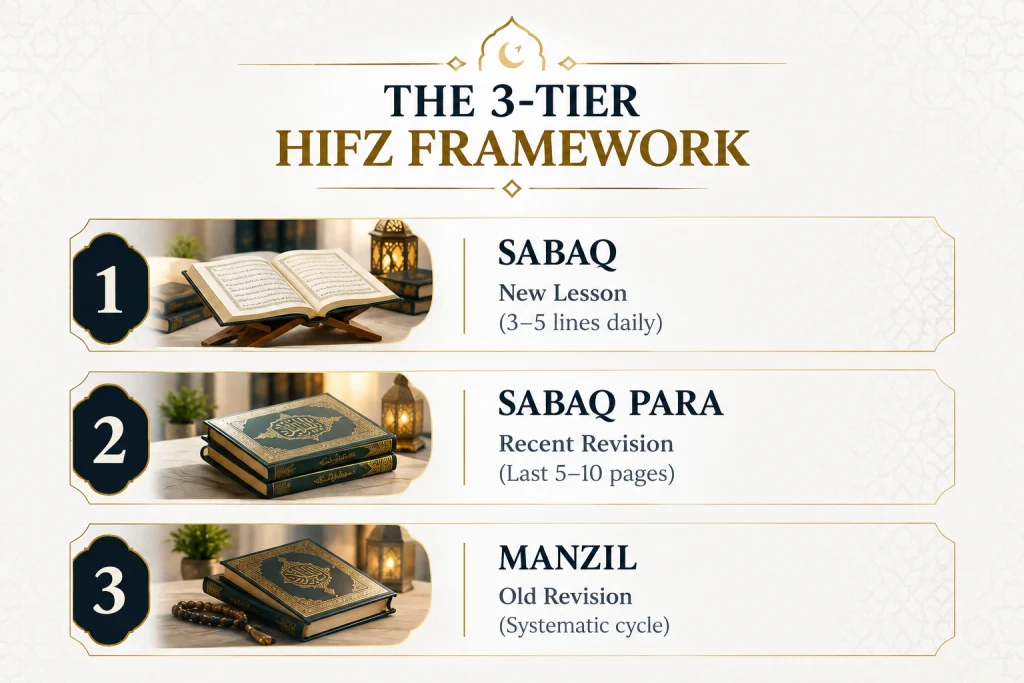
- Sabaq (The New Lesson): The brand-new lines you memorize today. For a working adult, this should be small-typically 3 to 5 lines per day. Quality always beats quantity.
- Sabaq Para / Sabqi (Recent Revision): The portion you memorized over the past 30 days (usually 5 to 10 pages). Because this material is still settling into long-term memory, it requires daily review with your teacher.
- Manzil / Muraja’ah (Old Revision): The solid portions you memorized months or years ago. You review a fixed portion daily in a continuous cycle to ensure older Surahs never fade.
The primary reason adult self-study fails is that adults often focus 100% of their energy on Sabaq while ignoring Manzil. Without structured revision, previously memorized chapters slowly slip away.
Time Budgeting: Schedules for Working Adults vs. Stay-at-Home Parents
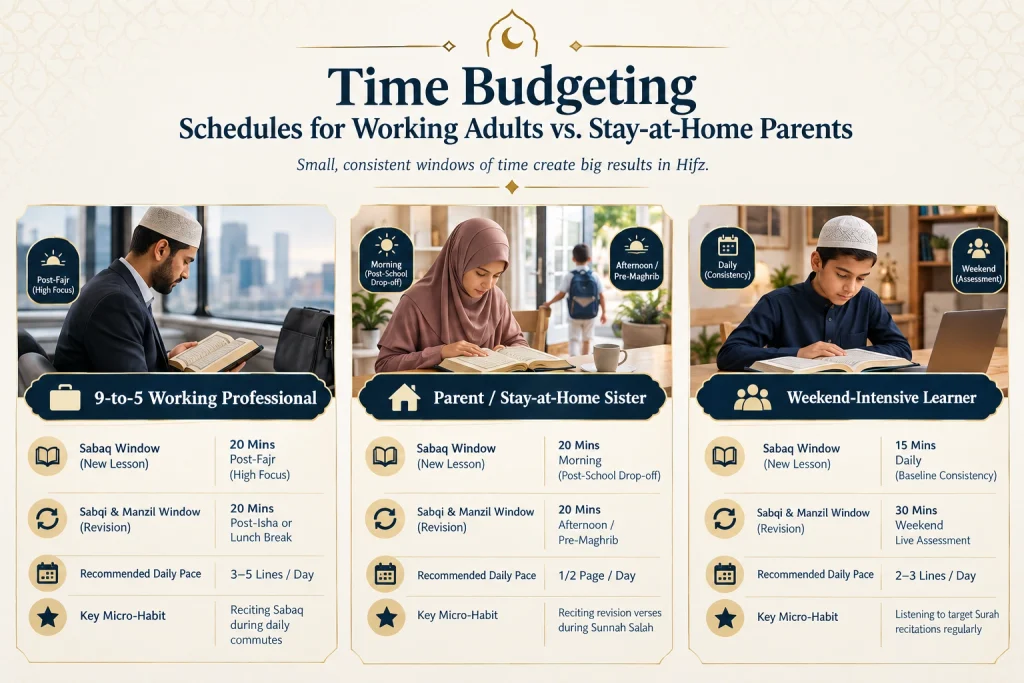
You do not need four uninterrupted hours every day to complete Hifz. Consistency over short daily windows yields far better results than exhausting weekend cramming sessions.
| Schedule Persona | Sabaq Window (New Lesson) | Sabqi & Manzil Window (Revision) | Recommended Daily Pace | Key Micro-Habit |
| 9-to-5 Working Professional | 20 Mins Post-Fajr (High Focus) | 20 Mins Post-Isha or Lunch Break | 3–5 Lines / Day | Reciting Sabaq during daily commutes |
| Parent / Stay-at-Home Sister | 20 Mins Morning (Post-School Drop-off) | 20 Mins Afternoon / Pre-Maghrib | 1/2 Page / Day | Reciting revision verses during Sunnah Salah |
| Weekend-Intensive Learner | 15 Mins Daily (Baseline Consistency) | 30 Mins Weekend Live Assessment | 2–3 Lines / Day | Listening to target Surah recitations regularly |
The 4 Critical Mistakes Adult Hifz Students Make (And How to Avoid Them)
1. Rushing Volume Over Accuracy
Setting unrealistic goals-such as trying to memorize a full page every day—leads to burnout. When you rush, your letter articulation suffers, and weak memory leads to hesitation during recitation.
2. Neglecting Auditory Preparation
Attempting to memorize directly from the printed page without listening to a professional reciter first is a common pitfall. Always listen to your assigned passage 5 to 10 times from a qualified Qari to lock the correct rhythm and vowels into your mind before memorizing.
3. The “Weekend Crammer” Fallacy
Studying for three hours on Sunday while skipping Monday through Friday does not work for long-term retention. The brain requires daily repetition to transfer information from short-term memory into permanent storage. Twenty minutes every morning builds stronger retention than sporadic weekend sessions.
4. Self-Guided Study Without Scholar Supervision
Attempting Hifz without a qualified teacher often results in uncorrected mistakes. Mispronouncing a single letter (Makhraj) can alter the entire meaning of a verse.
If you notice ongoing struggles with fundamental letter outputs, stepping back to complete an online Noorani Qaida course fixes underlying habits before you memorize bad patterns permanently.
Life Transformations: What Adults Experience After Starting Hifz
Adults who commit to daily Quran memorization report profound personal transformations:
- Spiritual Tranquility (Sakinah): Beginning your day with the Quran clears away daily mental stress and provides deep emotional focus.
- Elevated Family Leadership: Leading family prayers at home while reciting newly memorized passages brings immense joy and spiritual strength to the household.
- A Living Example for Your Children: When children see their parents sitting with the Mushaf every morning, Quranic study becomes a natural, valued part of daily home life.
Need a Customized Hifz Schedule That Fits Your Work Hours?
Our Ijazah-certified scholars create a personalized 1-on-1 memorization plan suited to your work schedule, learning pace, and current level.
Claim Your Free 1-on-1 Hifz Assessment Class →
Why Guided Supervision Matters: The Al Hamd Online Hifz System
Self-study apps cannot listen to your recitation or catch subtle mispronunciations. Correcting errors requires live, 1-on-1 guidance under a trained instructor.
Al Hamd Islamic Center stands among the top online Quran academies globally, serving families across the USA, UK, Canada, and Australia. The academy operates with over 200 Ijazah-certified teachers who provide structured, individual feedback during every lesson.
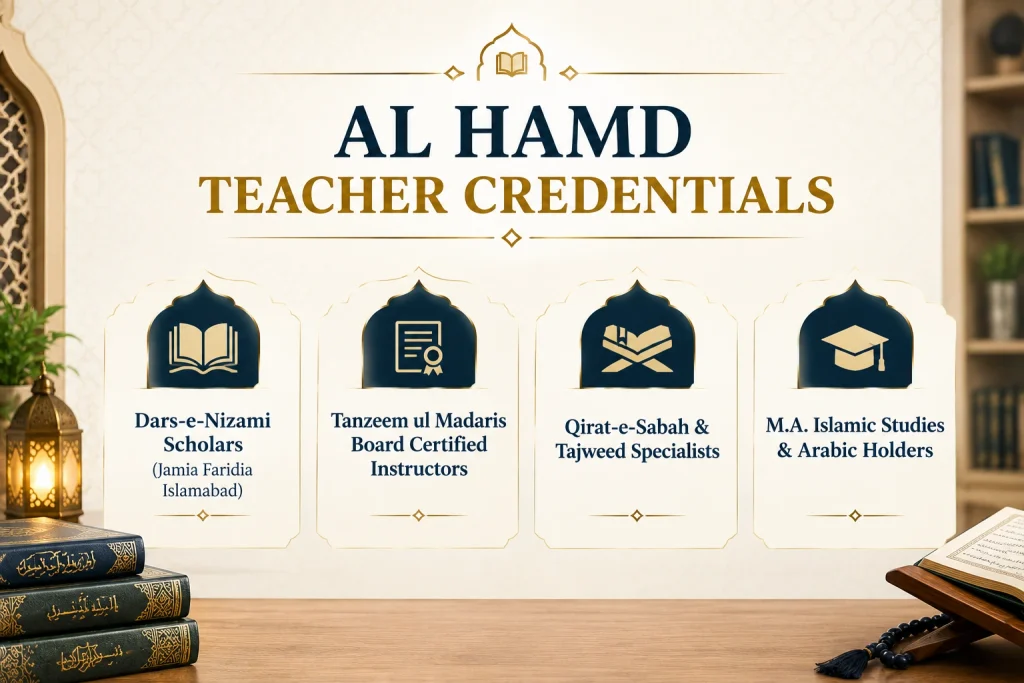
Our faculty includes verified scholars who understand adult learning needs:
- Ustadh Sadiq ur Rehman: A Dars-e-Nizami graduate from Jamia Faridia Islamabad with specialization in Qirat-e-Sabah and Tajweed correction.
- Ustadh Waseem Abbas: A scholar from Jamia Darul Tafseer wal Hadees specializing in long-term adult Hifz retention strategies.
- Ustadha Komal Kiani: Certified by the Tanzeem ul Madaris Board, specializing in Tafseer and foundational Tajweed.
- Ustadha Sidra Zulfiqar: Holds double Master’s degrees in Arabic and Islamic Studies from Jamia Zia-ul-Uloom.
In real lessons, Ustadh Sadiq ur Rehman and Ustadh Waseem Abbas observe that adult students who skip foundational letter practice often stumble on similar vocal traps. For instance, confusing the soft Ain (ع) with a glottal Alif (أ) or blurring heavy letters like Saad (ص) into soft Seen (س) can alter sacred meanings entirely. Live instructors catch these subtle vocal slips instantly before muscle memory freezes them into permanent habits.
How long does it take for a busy adult to complete an online hifz course?
On average, a busy working professional dedicating 30 minutes daily to an online hifz course completes the entire Quran in 3 to 5 years. However, memorizing key Surahs (such as Surah Al-Baqarah, Yaseen, or Mulk) or Juz 30 typically takes between 3 to 6 months.
For sisters and mothers seeking private study, Al Hamd provides over 20 certified female Quran teachers for one-on-one sessions.
Every adult student receives a personalized learning dashboard to track daily Sabaq, Sabqi, and Manzil progress. To experience this system with zero risk, you can take advantage of our 3-day free trial class before enrolling in a structured online Hifz course for adults.
Frequently Asked Questions
Yes. You can begin memorizing short Surahs while refining your pronunciation. During your initial sessions, your instructor evaluates your letter articulation (Makharij). Fixing fundamental errors early prevents you from memorizing mistakes that become difficult to unlearn later.
An effective hifz schedule for busy adults requires 30 to 45 minutes daily. This is best split into two short sessions: 20 minutes after Fajr for new lesson memorization (Sabaq) and 15 to 20 minutes in the evening for revision (Sabqi and Manzil).
The most reliable method is the classical 3-tier revision framework (Sabaq, Sabaq Para, Manzil). Reciting your daily revision portions during voluntary (Sunnah and Nafl) prayers or reviewing them in live 1-on-1 sessions ensures strong retention without memory decay.
Yes. Flexible 1-on-1 hifz online classes allow working professionals to adjust session times around business travel, corporate meetings, or shift changes, ensuring consistent study without missing classes.
Yes. Al Hamd Islamic Center features over 20 certified female Quran scholars holding Ijazah credentials and degrees in Islamic Studies. Sisters can learn in a private, 1-on-1 online environment tailored to their individual schedules.
Take the First Step Today
Age is never a barrier to preserving the Quran in your heart. Allah evaluates your sincere intention (Niyyah), your daily effort, and your consistency rather than speed.
Every single letter you recite brings ten rewards, and the extra effort you make to balance work and family life with Quranic study carries immense spiritual value. Begin your journey with an adult quran class at Al Hamd Islamic Center and carry the divine word with confidence.
Take Your First Step Toward Becoming a Hafiz Today
Join Al Hamd Islamic Center and begin your personalized adult Hifz journey under the guidance of Ijazah-certified scholars.
Start Your 3-Day Free Trial Class Now →
Questions? Contact our international support team directly:
USA: +1 415-725-6147 | Pakistan: +92 340-5245553 | Australia: +61 480 810 652

Written by Ustadh Sadiq ur Rehman | Dars-e-Nizami Graduate, Jamia Faridia Islamabad | Tajweed & Hifz Specialist
Ustadh Sadiq ur Rehman is an Islamic scholar and educator with extensive experience guiding adult learners in Tajweed, Qirat, and Quranic memorization. Having trained under senior scholars at Jamia Faridia, he specializes in structuring practical, high-retention Hifz routines for working professionals and busy Western Muslim families.