



Quran assessment is a structured evaluation of a student’s Quran reading, Tajweed application, memorization strength, and learning progress. Qualified Quran teachers review recitation, identify mistakes, measure improvement, and create personalized plans that help students build accurate and confident Quran skills.
Many Muslim parents in the USA, UK, Canada, and Australia share the same concern: “What if my child learns the Quran incorrectly and develops recitation habits that become difficult to fix later?”
A child may attend Quran classes regularly, but attendance alone does not show real improvement. Parents need to know if their child is improving in pronunciation, reading fluency, Tajweed, and memorization.
A proper quran assessment gives parents a clear picture of their child’s current level. It helps teachers identify weak areas, correct mistakes early, and guide students through the right learning path.
This guide explains how qualified Quran teachers assess reading, Tajweed, and Hifz progress using structured methods that support a lifelong connection with the Quran.
Who This Guide Is For
This guide is especially helpful for:
- Muslim parents in Western countries who want to monitor their child’s Quran learning journey.
- Families searching for qualified online Quran teachers with authentic Islamic credentials.
- Parents concerned about incorrect pronunciation, weak Tajweed, or poor memorization habits.
- Students beginning Noorani Qaida, Quran reading, Tajweed, or Hifz programs.
What Is Quran Assessment and Why Does It Matter?
Quran assessment is the process of checking a student’s ability to read, recite, memorize, and apply Quran learning skills correctly. It allows teachers to understand what a student already knows and what needs improvement.
A good assessment does not focus only on speed. A student who completes more pages may still need help with Makhraj, pronunciation, or Tajweed rules.
Qualified Quran teachers usually evaluate:
- Reading accuracy
- Arabic letter pronunciation
- Tajweed application
- Memorization strength
- Revision habits
- Recitation confidence
For example, a child may recognize Arabic letters but struggle with connecting words smoothly. Another student may memorize verses quickly but need stronger revision methods to maintain accuracy.
Experienced teachers observe these patterns during lessons and adjust their approach according to the student’s needs.
The purpose of assessment is simple: help each student learn the Quran correctly from the beginning.
How Quran Teachers Evaluate Reading Progress Step by Step
Every child starts their Quran journey from a different point. Some children begin with Noorani Qaida, while others already know basic reading skills.
| Assessment Area | Teacher Evaluates |
|---|---|
| Reading | Fluency, pronunciation |
| Tajweed | Rules, Makharij |
| Hifz | Accuracy, retention |
| Revision | Consistency |
| Confidence | Independent recitation |
The Al Hamd Quran Learning System begins by understanding the student’s current ability before planning future lessons.
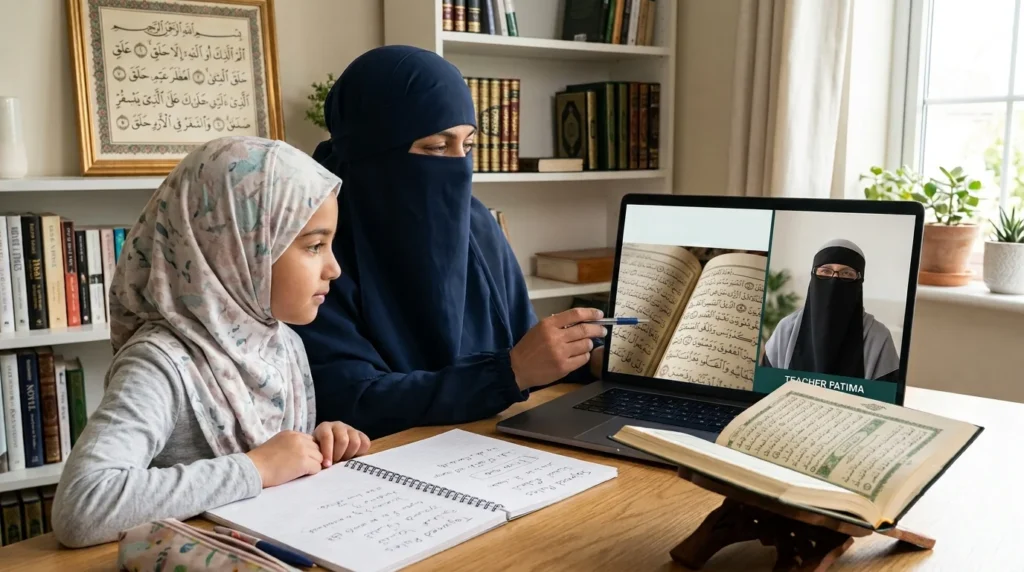
Step 1: Initial Reading Level Evaluation
The first evaluation helps teachers understand:
- Arabic letter recognition
- Ability to combine letters
- Reading confidence
- Common pronunciation difficulties
For beginners, Noorani Qaida provides the foundation for correct Quran reading. Teachers check whether students understand letter sounds before moving toward longer Quranic words.
Teachers often notice that students who rush through basic foundations may later struggle with pronunciation correction. Early evaluation prevents these issues from becoming long-term habits.
Step 2: Checking Quran Recitation Accuracy
After identifying the student’s level, teachers evaluate practical recitation skills.
They observe:
- Correct pronunciation of Arabic letters
- Reading flow
- Proper stopping points
- Common recitation errors
A trained teacher listens for details that many beginners cannot recognize themselves. For example, a student may pronounce a similar-looking Arabic letter incorrectly without realizing the difference.
This stage helps create a personalized learning plan instead of using the same approach for every student.
How Tajweed Assessment Measures Recitation Quality
Tajweed protects the accuracy and beauty of Quran recitation. It teaches students how to pronounce Quranic words according to established rules.
A proper tajweed assessment checks whether students apply these rules during actual recitation.
Checking Makhraj and Letter Pronunciation
Teachers carefully observe how students produce Arabic letters.
They focus on:
- Correct articulation points
- Throat and tongue positions
- Heavy and light letters
- Similar letter sounds
For example, mistakes between letters with similar sounds can affect correct recitation. Teachers trained in Tajweed help students correct these issues through repeated practice.
Evaluating Tajweed Rules in Practice
Students are assessed on their ability to apply tajweed rules such as:
- Madd (elongation)
- Noon Sakinah and Tanween
- Meem Sakinah
- Qalqalah
- Ghunnah
A strong Tajweed assessment does not only test memorized definitions. It checks whether students naturally apply rules while reciting the Quran.
At Al Hamd Islamic Center, teachers use structured correction methods. Students repeat difficult words, practice specific sounds, and receive individual guidance until improvement appears.
How Qualified Teachers Support Tajweed Improvement
Teacher expertise plays a major role in Quran learning.
For example, Sadiq ur Rehman has Dars-e-Nizami education from Jamia Faridia Islamabad and specializes in Tajweed with Qirat-e-Sabah training. His experience allows students to receive guidance based on traditional Quran teaching principles.
Similarly, teachers with Tajweed and Islamic Studies backgrounds help students understand not only how to recite but also how to build consistent practice habits.
Qualified Quran teachers follow established Tajweed principles passed through authentic chains of Islamic scholarship. Their role is not only to correct mistakes but also to help students develop confidence, consistency, and a lifelong connection with the Quran.
Al Hamd Islamic Center has more than 200 Ijazah-certified teachers serving families in the USA, UK, Canada, Australia, and other regions. The academy focuses on authentic Quran education through qualified instructors and structured learning.
How Teachers Conduct Hifz Assessment for Quran Memorization
Memorizing the Quran is a journey that requires patience, consistency, and proper guidance. A student may memorize new verses quickly, but without strong revision habits, retention can become difficult.
A structured hifz assessment helps teachers evaluate both memorization progress and the student’s ability to maintain what they have learned.
Teachers do not only ask, “How much Quran has the student memorized?” They also ask:
- Can the student recite accurately?
- Can they remember previous portions?
- Are mistakes increasing or decreasing?
- Is the revision routine effective?
This balanced approach helps students develop strong and lasting memorization.

Measuring Memorization Accuracy
During Hifz evaluation, teachers check:
- Recently memorized verses
- Accuracy without prompts
- Mistake patterns
- Connection between verses
For example, a teacher may ask a student to recite a newly memorized portion and then test a previous section from an earlier lesson. This helps measure both short-term learning and long-term retention.
Waseem Abbas, a scholar from Jamia Darul Tafseer wal Hadees with Hifz background and more than 4 years of teaching experience, supports students by focusing on accuracy, revision discipline, and consistent improvement.
His approach reflects an important principle in Quran memorization: strong retention matters as much as completing new portions.
Building a Sustainable Hifz Routine
Successful Hifz students usually follow a clear routine that includes:
- Daily revision of previous memorization
- Regular teacher review sessions
- Practice of weaker sections
- Gradual memorization goals
Teachers adjust the pace according to the student’s age, ability, and consistency.
A younger child may need shorter lessons with more repetition, while an older student may handle longer memorization sessions. Assessment helps teachers choose the right balance.
Quran Learning Benchmarks: Understanding Your Child’s Progress
Many parents ask, “How do I know if my child is moving in the right direction?”
Clear Quran learning benchmarks help parents understand progress without comparing their child unfairly with others.
Here’s an expanded explanation of the table that you can place directly below it in your article:
Understanding the Learning Stages
Every student learns the Quran at their own pace. Some children become confident readers quickly, while others need more time to build a strong foundation. A qualified Quran teacher regularly evaluates each student’s progress and adjusts lessons to match their learning needs. The focus is not on speed but on developing accurate recitation, confidence, and a lifelong connection with the Quran.
Beginner Stage
At the beginner level, the teacher focuses on Noorani Qaida, Arabic letter recognition, correct pronunciation (Makharij), and basic reading skills. Students learn how to identify letters, connect sounds, and read simple Quranic words correctly. By the end of this stage, they can recognize Arabic letters confidently and begin reading the Quran with proper pronunciation.
Intermediate Stage
Once students understand the basics, they move to improving their Quran reading fluency. Teachers introduce Tajweed rules, correct pronunciation mistakes, and help students read more smoothly without hesitation. Regular practice strengthens accuracy, making Quran recitation more natural and confident.
Advanced Stage
Advanced students focus on Hifz (Quran memorization), revision, and mastering recitation quality. Teachers monitor memorization progress, ensure previously memorized portions remain strong, and help students apply Tajweed correctly throughout their recitation. The goal is to achieve confident, accurate, and beautiful Quran recitation while maintaining long-term retention of memorized Surahs.
These benchmarks give families a realistic understanding of progress. A child’s success is not measured only by speed but by accuracy, consistency, and improvement.
Common Mistakes Parents Should Avoid When Tracking Quran Progress
Parents naturally want their children to succeed. However, some common mistakes can make Quran learning more stressful or less effective.
Focusing Only on Completion Speed
Completing more pages does not always mean better Quran learning.
A student may finish more lessons but still struggle with pronunciation or Tajweed. Correct foundations should come before rushing ahead.
Teachers often see students improve faster when they slow down, fix mistakes, and build accurate habits.
Comparing One Child’s Progress With Another
Every child has a unique learning journey.
Factors such as:
- Age
- Previous Arabic exposure
- Practice consistency
- Learning style
can affect progress.
A child who needs more time is not necessarily struggling. The right assessment helps teachers create realistic goals for each student.
Ignoring Regular Teacher Feedback
Parents should stay connected with teachers throughout the learning journey.
Regular feedback helps families understand:
- What the child is doing well
- Which areas need practice
- How parents can support learning at home
A strong parent-teacher connection creates better results.
What Parents Notice After Starting Structured Quran Progress Evaluation
When children learn with regular evaluation, parents often notice changes beyond reading improvement.
Children Become More Confident
Many students hesitate when reading because they fear making mistakes.
When teachers provide gentle correction and clear goals, children become more comfortable reciting aloud.
Over time, students learn that mistakes are part of improvement.
Recitation Becomes More Accurate
With regular Tajweed correction, students gradually improve:
- Pronunciation
- Fluency
- Reading confidence
- Application of Quran rules
The future goal is a child who can recite the Quran with calmness, accuracy, and understanding.
Parents Gain Clear Understanding
Parents no longer have to guess whether their child is improving.
Through regular updates, they understand:
- Current learning level
- Progress areas
- Practice needs
- Next learning goals
Al Hamd Islamic Center supports families through transparent communication and structured progress tracking.
Parents can also learn more about tracking Quran learning development through this resource:
How Al Hamd Islamic Center’s Quran Assessment Approach Builds Trust
Choosing a Quran teacher is a serious decision. Many parents worry about one important issue:
“Will my child learn the Quran correctly from the beginning?”
This concern is understandable because early pronunciation habits can affect future recitation.
Al Hamd Islamic Center addresses this through the Al Hamd Assessment Framework, where students receive guidance from qualified Quran educators.
Qualified Teachers With Authentic Islamic Credentials
Al Hamd Islamic Center has more than 200 Ijazah-certified teachers, including specialists in Quran recitation, Tajweed, Hifz, and Islamic Studies.
The teaching team includes educators such as:
Sadiq ur Rehman
- Dars-e-Nizami graduate
- Studied at Jamia Faridia Islamabad
- Tajweed specialization with Qirat-e-Sabah training
- More than 3 years of teaching experience
He helps students improve pronunciation accuracy and apply Tajweed rules correctly.
Waseem Abbas
- Scholar from Jamia Darul Tafseer wal Hadees
- Hifz background
- More than 4 years of teaching experience
He focuses on helping students develop strong memorization and revision habits.
Komal Kiani
- Tajweed specialist
- Trained through Tanzeem ul Madaris Board
- Tafseer training background
She supports students in improving recitation quality while developing deeper Quran understanding.
Sidra Zulfiqar
- Double Masters in Arabic and Islamic Studies
- Graduate of Jamia Zia-ul-Uloom
Her background supports students studying Quran and Islamic Studies with greater understanding.
A Structured Teaching Methodology for Better Quran Progress
A good Quran assessment system depends on more than testing students. It requires a clear teaching method that identifies weaknesses, improves skills, and supports steady growth.
The Al Hamd Quran Learning System combines traditional Islamic teaching principles with effective online learning methods.
The process includes:
- Initial student level assessment before starting lessons
- One-on-one correction of reading and Tajweed mistakes
- Personalized Hifz and revision plans
- Regular teacher feedback for parents
- Progress tracking based on individual learning goals
For example, if a student struggles with a specific Makhraj issue, the teacher does not simply continue the lesson. The teacher isolates the sound, explains the correct articulation, and provides repetition exercises until the student improves.
This focused approach helps prevent incorrect habits and builds stronger Quran foundations.
Safe and Supportive Online Quran Learning for Children
Parents often want to know whether online Quran classes can provide the same care and attention as traditional learning environments.
A safe learning environment depends on qualified teachers, respectful communication, and proper supervision.
Al Hamd Islamic Center focuses on:
- Monitored online classes
- Qualified Quran instructors
- Parent-teacher communication
- Child-friendly teaching methods
- Respectful Islamic learning environment
Teachers understand that children learn best when they feel comfortable asking questions and correcting mistakes.
The goal is not only to improve recitation but also to help children develop love and respect for the Quran.
Transparent Progress Tracking for Parents
Parents should not have to wonder about their child’s improvement.
A reliable progress system allows families to understand:
- Current Quran reading level
- Tajweed strengths and weaknesses
- Memorization progress
- Recommended practice areas
Regular updates also help parents support and measure Quran learning progress at home.
For example, if a teacher notices that a child struggles with revision consistency, the teacher can suggest a shorter but more regular practice routine instead of increasing memorization pressure.
Parents can also explore additional guidance about Quran teaching methods through.
Why Certified Quran Teachers Make a Difference
Teaching the Quran requires knowledge, patience, and responsibility.
A certified teacher understands the importance of preserving correct recitation and guiding students according to authentic Islamic learning traditions.
Al Hamd Islamic Center’s teachers include specialists with qualifications such as:
- Ijazah certification
- Dars-e-Nizami education
- Hifz specialization
- Tajweed training
- Qirat-e-Sabah studies
- Islamic Studies qualifications
These credentials provide parents with confidence that their children are learning from educators with proper Islamic training.
How Do Quran Teachers Measure Student Progress?
Quran teachers measure student progress by checking reading accuracy, Tajweed application, memorization retention, and consistency. They review mistakes, test previous lessons, evaluate recitation quality, and provide feedback to create a personalized Quran learning plan for each student.
Frequently Asked Questions
A Quran assessment evaluates a student’s reading ability, pronunciation, Tajweed skills, memorization level, and learning habits. Teachers identify strengths and weaknesses, check common mistakes, and create suitable learning goals. The assessment helps determine whether a student needs support with Noorani Qaida, recitation, Tajweed, or Hifz.
Children benefit from regular progress evaluations because teachers can identify improvement areas early. Many students receive weekly lesson feedback and periodic progress reviews. These evaluations help teachers adjust lesson difficulty, improve weak areas, and keep parents informed about their child’s Quran learning journey.
Teachers assess Hifz progress by testing newly memorized verses, reviewing previous portions, and checking retention strength. They monitor mistakes and revision habits to ensure students maintain accuracy. A strong Hifz assessment focuses on quality, consistency, and long-term memorization rather than only the amount completed.
Certified Quran teachers have specialized knowledge of Quran recitation standards and Islamic education. Teachers with Ijazah, Tajweed, Hifz, and Islamic Studies backgrounds can recognize detailed mistakes and guide students correctly. Their training helps protect students from developing incorrect recitation habits.
Conclusion
A structured quran assessment process helps parents understand whether their child is truly improving in Quran reading, Tajweed, and memorization.
The biggest concern for many families is that children may learn incorrectly and develop habits that become harder to correct later. Regular evaluation from qualified teachers helps prevent this by identifying mistakes early and providing focused guidance.
Al Hamd Islamic Center supports families across the USA, UK, Canada, Australia, and other regions through experienced Ijazah-certified teachers and the Al Hamd Quran Learning System.
Parents can begin with a free trial class to understand their child’s current level, meet qualified teachers, and discover a suitable Quran learning plan without any long-term commitment.