




Choosing between Tajweed, Hifz, and Tafseer depends on your current reading fluency and learning goals. Tajweed teaches correct Arabic pronunciation and articulation, Hifz focuses on complete Quran memorization, and Tafseer explores deep translation, historical context, and spiritual exegesis of the verses.
Every evening in households across the West, Muslim parents face a quiet dilemma. You want your child-or yourself to build a genuine, lifelong connection with the Quran. Yet, staring at a list of online course options can feel overwhelming. Should you focus on mastering proper pronunciation first? Jump straight into memorization? Or dive into the meanings and context behind the verses? Enrolling in the wrong track too early leads to frustration, burnout, and abandoned goals. This comprehensive guide cuts through the confusion, comparing Tajweed, Hifz, and Tafseer side-by-side so you can map out a clear, step-by-step Quranic learning journey.
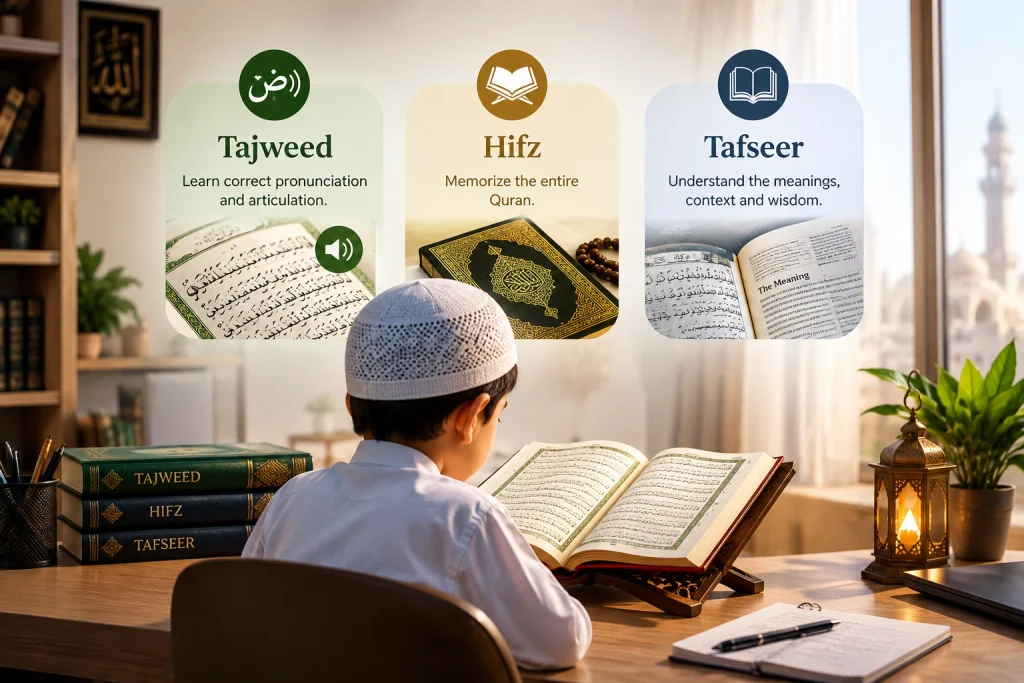
Who This Is For
- Muslim Parents in the USA & West: Seeking structured, reliable online Quran education that fits seamlessly around demanding public school schedules.
- Adult Beginners: Wanting to correct their recitation, understand what they read in Salah, or finally fulfill a long-held dream of memorization.
- Students Transitioning Levels: Moving from basic reading (Noorani Qaida) into formal specialized disciplines like Tajweed or Hifz.
- Lifelong Learners: Looking to move beyond mechanical reading to explore the rich contextual depths of Tafseer.
What is Tajweed? The Foundation of Correct Recitation
Tajweed literally means “to make well” or “to adorn.” It is the precise science of mastering articulation points (Makharij) and the characteristics of Arabic letters. Without it, subtle shifts in sound can unintentionally alter the meaning of sacred verses.
When students begin with foundational programs at Al Hamd Islamic Center, our teachers frequently observe how early phonics work prevents deep-seated pronunciation errors. Instructors like Komal Kiani, trained via the Tanzeem ul Madaris Board, focus heavily on these mechanical roots. Students learn rules governing Noon Sakinah, Meem Sakinah, and proper vowel elongation (Madd) before moving forward.
What is Hifz? The Path of Heart Memorization
Hifz is the sacred tradition of committing the entire Holy Quran to memory. It requires absolute consistency, patience, and a structured daily cycle.
The memorization process relies on three daily pillars: learning new lines (Sabaq), reviewing recent portions (Sabqi), and maintaining older juz allocations (Manzil). Rushing this process without supervision often leads to weak retention. Under the guidance of experienced educators like Waseem Abbas, a scholar from Jamia Darul Tafseer wal Hadees with over 4 years of teaching experience, students build robust revision habits that protect their memorization for life.

What is Tafseer? Unlocking the Divine Message
Tafseer shifts the focus from recitation mechanics and memory retention to deep comprehension. It encompasses word-by-word translation, historical context (Asbab al-Nuzul), and practical spiritual application.
While adults often jump straight into translation studies, a successful foundation requires basic familiarity with Arabic vocabulary or fluent reading mechanics. Studying Tafseer allows learners to understand the wisdom behind the verses they recite in every rakah, transforming routine prayers into deeply reflective conversations with Allah.
Side-by-Side Comparison: Tajweed vs. Hifz vs. Tafseer
| Course | Core Focus | Ideal Starting Level | Primary Outcome |
| Tajweed | Correct pronunciation & Makharij | Absolute beginners & kids | Flawless, beautiful recitation in Salah |
| Hifz | Complete Quran memorization | Students with solid reading fluency | Memorizing the entire Holy Quran |
| Tafseer | Translation, context & exegesis | Intermediate learners & adults | Deep spiritual understanding of Quranic text |
Common Mistakes to Avoid When Choosing a Course
- Skipping Tajweed to rush into Hifz: Memorizing text with broken pronunciation ingests errors into long-term memory, which become twice as hard to fix later.
- Starting heavy Tafseer without basic grounding: Diving into complex exegesis without understanding basic Quranic context causes cognitive overload.
- Overcommitting to unrealistic schedules: Forcing children in Western schools into rigid, multi-hour daily blocks leads straight to severe academic burnout.
What Parents Notice After Starting the Right Program
When students follow a structured pathway tailored to their true skill level, the transformation is clear. Parents across the USA, UK, Canada, and Australia notice a distinct calm and confidence in their children’s daily Salah recitation. Instead of homework friction, learning sessions become anticipated milestones. A natural bridge forms, turning mechanical reading into a living, breathing connection with the faith.
Built on Verified Expertise: The Al Hamd Islamic Center Difference
As one of the top 10 global online Quran academies, Al Hamd Islamic Center unites over 200 Ijazah-certified teachers under one roof. We reject anonymous directories in favor of named, verifiable scholarship.
Our faculty features rigorous academic backgrounds. For instance, Ustadh Sadiq ur Rehman brings specialized Dars-e-Nizami credentials from Jamia Faridia Islamabad, holding specific expertise in Qirat-e-Sabah and Tajweed. Similarly, Sidra Zulfiqar contributes double Master’s qualifications in Arabic and Islamic Studies from Jamia Zia-ul-Uloom.

Using the structured Al Hamd Assessment Framework, our instructors monitor every student through interactive one-on-one sessions, safe online portals, and regular parent progress logs.
Can you start Hifz without learning Tajweed first? No, mastering basic Tajweed rules is essential before beginning Hifz. Learning proper articulation and letter rules first prevents memorizing incorrect pronunciations into long-term memory, which becomes much harder to correct later.
Frequently Asked Questions
Beginners should always start with Noorani Qaida followed immediately by foundational Tajweed classes. Establishing correct phonetic habits early ensures every subsequent step-whether reading, memorizing, or studying meaning-is built on a secure and accurate foundation.
Tajweed is the rules governing how letters and words are pronounced correctly during recitation, while Hifz is the distinct discipline of committing the entire text of the Quran to memory. Hifz students must apply Tajweed rules continuously while memorizing.
Completion time varies based on student age, daily time dedication, and retention capacity, typically ranging from 3 to 5 years for full memorization. Consistent daily practice with an expert teacher matters far more than rushing through pages
Fluent Arabic is not strictly required to start introductory Tafseer classes, as instructors break down meanings, context, and lessons directly in English. However, pairing Tafseer with basic Arabic vocabulary or Tajweed vastly enriches the overall learning experience.
Reputable online academies offer highly flexible, customizable scheduling across North American, European, and Australian time zones. Sessions are structured in manageable 30-to-45-minute blocks that fit comfortably around regular school and extracurricular activities.
Conclusion
Navigating the paths of Tajweed, Hifz, and Tafseer does not have to be a guessing game. By aligning your starting point with current reading skills and long-term goals, you set the stage for a fulfilling, sustainable journey with the Quran. Whether you want to perfect your recitation mechanics, commit the verses to memory, or dive deep into divine meaning, structured guidance makes all the difference. Experience our certified teaching approach firsthand with a zero-risk trial session today.
Written by Ustadh Sadiq ur Rehman | Dars-e-Nizami Graduate & Tajweed Specialist | Ustadh Sadiq ur Rehman is a dedicated Islamic educator with years of experience helping students of all ages across the West connect deeply with the Quran. His teaching approach bridges traditional scholarly precision with modern, student-friendly digital instruction.