



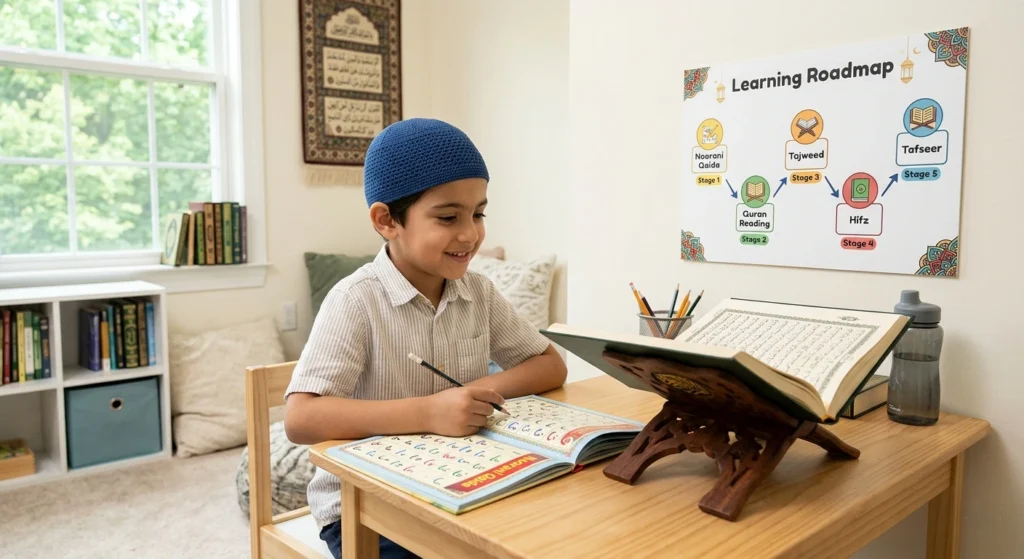
Many parents celebrate when their child finishes Noorani Qaida. It marks months of effort and an important step in Quran education.
Then a new question appears: What happens after Noorani Qaida?
Some families think the next step is memorization. Others focus on Tajweed. Many simply do not know which stage should come next.
This uncertainty is common. Noorani Qaida teaches the foundation of Quran reading, but it is only the beginning of a much larger journey.
A clear roadmap helps students move from recognizing letters to reading the Quran fluently, applying Tajweed correctly, memorizing verses, and understanding Allah’s message with confidence.
What Happens After Noorani Qaida?
After Noorani Qaida, students begin reading the Quran directly while applying basic pronunciation skills. They then progress through Tajweed, fluency development, advanced recitation, memorization, and Quran understanding. Each stage builds upon the previous one and creates a strong foundation for lifelong Quran learning.

Why This Stage Matters More Than Many Parents Realize
Completing Noorani Qaida is similar to learning the alphabet before reading books.
A student may recognize letters and understand basic reading rules. However, reading actual Quranic verses requires a different level of skill.
This transition period is important because it shapes future habits.
Students who receive proper guidance often develop strong recitation skills. Students who rush through the process may struggle with pronunciation mistakes that become harder to correct later.
For parents, this stage can determine whether a child builds confidence in Quran learning or begins to feel frustrated.
The goal is not simply moving to the next course. The goal is building a path that supports long-term success.
Who This Quran Learning Roadmap Is For
This guide is designed for:
- Children who recently completed Noorani Qaida
- Parents looking for clear next steps
- Teenagers improving their Quran recitation
- Adult beginners learning later in life
- New Muslims seeking structured Quran education
- Families in the USA searching for a complete learning pathway
Whether the learner is seven years old or seventy, the overall progression remains similar.
The Complete Quran Learning Journey
Most successful students follow a structured sequence rather than jumping between different subjects.
The journey usually looks like this:
- Quran reading
- Basic Tajweed
- Reading fluency
- Advanced Tajweed
- Hifz (memorization)
- Quran understanding and Tafseer
- Lifelong Quran study
Each stage prepares students for the next.
Stage 1: Start Reading the Quran
The first step after Noorani Qaida is reading actual Quranic text.
Most teachers begin with shorter surahs from Juz Amma. These chapters are familiar to many students because they hear them regularly in prayer.
During this stage, students learn to:
- Read complete verses
- Connect words smoothly
- Improve pronunciation
- Build reading confidence
- Follow teacher corrections
Many parents become concerned when their child reads slowly.
In reality, slow reading often shows that a student is paying attention to accuracy. Careful reading builds stronger habits than rushing through verses.
A child who pauses to pronounce letters correctly is usually progressing well.
Stage 2: Learn Basic Tajweed
Once students begin reading Quranic verses, they need Tajweed instruction.
Tajweed teaches the correct way to pronounce every letter and word during recitation.
Without Tajweed, students may read the text but still develop pronunciation errors.
Basic Tajweed often includes:
- Makharij (points of articulation)
- Ghunnah
- Noon Sakinah rules
- Meem Sakinah rules
- Madd rules
- Basic stopping rules
These lessons help students recite more accurately and confidently.
Should students learn Tajweed after Noorani Qaida?
Yes. Tajweed is usually the next step after Noorani Qaida because it teaches proper Quran pronunciation. Learning Tajweed early helps students develop correct recitation habits and prevents mistakes from becoming permanent.
Stage 3: Build Quran Reading Fluency
Reading and reading fluently are not the same thing.
A student may read correctly but still hesitate frequently or struggle with longer passages.
Fluency develops through regular practice and guided correction.
At this stage, students focus on:
- Reading smoothly
- Reducing pauses
- Improving confidence
- Recognizing common Quranic words
- Maintaining accuracy while increasing speed
Many learners experience a noticeable breakthrough during this phase.
A child who once struggled through a few lines may suddenly begin reading entire pages comfortably. This improvement often comes from consistency rather than natural ability.
Quran Learning Stages Comparison Table
| Stage | Primary Goal | Main Focus | Expected Outcome |
|---|---|---|---|
| Noorani Qaida | Foundation | Letters and sounds | Reading readiness |
| Quran Reading | Recognition | Reading verses | Basic recitation |
| Basic Tajweed | Accuracy | Pronunciation rules | Fewer mistakes |
| Fluency Building | Confidence | Smooth reading | Better flow |
| Advanced Tajweed | Excellence | Refined recitation | Beautiful recitation |
| Hifz | Retention | Memorization | Preserved Quran portions |
| Tafseer | Understanding | Meaning and reflection | Deeper connection |
Stage 4: Advanced Tajweed and Recitation Improvement
After developing fluency, students often focus on refining their recitation.
Advanced Tajweed improves subtle areas that beginners may not notice.
Students work on:
- More precise pronunciation
- Better articulation
- Improved rhythm
- Consistent application of rules
- Stronger listening skills
Even experienced reciters continue improving throughout their lives.
Advanced Tajweed is not a finish line. It is an ongoing process of refinement.
Stage 5: Hifz (Quran Memorization)
Many parents ask when memorization should begin.
The answer depends on the student’s readiness.
Strong reading skills usually make Quran memorization easier and more accurate.
Students who understand pronunciation rules often retain verses better because they recite them correctly from the beginning.
Before starting Hifz, most learners benefit from:
- Comfortable Quran reading
- Basic Tajweed knowledge
- Consistent study habits
- Regular teacher supervision
Many students begin with shorter surahs before moving to larger memorization goals.
Common Starting Surahs
- Surah Al-Fatihah
- Surah Al-Ikhlas
- Surah Al-Falaq
- Surah An-Nas
- Additional surahs from Juz Amma
These shorter chapters help students develop confidence and momentum.
Stage 6: Learn Quran With Understanding
Reading beautifully is valuable.
Understanding the Quran message creates a deeper relationship with the Quran.
As students mature, many begin studying:
- Translation
- Basic Arabic vocabulary
- Tafseer
- Historical context
- Practical lessons
This stage often changes how students engage with the Quran.
Instead of simply reciting verses, they begin reflecting on their meanings and applying those lessons in daily life.
For many families, this becomes one of the most rewarding parts of the journey.
How Long Does the Quran Learning Journey Take?
Every student progresses at a different pace.
Several factors influence results:
- Age
- Practice consistency
- Teacher quality
- Learning environment
- Parent involvement
- Class frequency
The following timeline offers a realistic guide.
| Learning Stage | Typical Time Range |
|---|---|
| Noorani Qaida Completion | 2–6 months |
| Basic Quran Reading | 1–3 months |
| Basic Tajweed | 3–6 months |
| Reading Fluency | 6–12 months |
| Advanced Tajweed | Ongoing |
| Hifz Preparation | 12+ months |
| Tafseer and Understanding | Lifelong |
These ranges vary widely.
Consistency matters more than speed.
A student who studies regularly for fifteen minutes daily often progresses faster than one who studies irregularly.
A Roadmap for Children vs Adults
One gap in many Quran learning guides is the assumption that all students learn the same way.
In reality, children and adults often have different needs.
Children
Children usually benefit from:
- Shorter lessons
- Interactive teaching
- Frequent encouragement
- Parent involvement
- Clear milestones
Adults
Adults often benefit from:
- Flexible schedules
- Goal-focused instruction
- Practical explanations
- Independent practice plans
- Progress tracking
The learning stages remain similar, but the teaching approach often changes.
Common Mistakes to Avoid After Noorani Qaida
Many students slow their progress because of avoidable mistakes.
1. Starting Hifz Too Early
Memorization becomes easier when reading skills are already strong.
2. Skipping Tajweed
Students who ignore Tajweed often need significant corrections later.
3. Practicing Inconsistently
Daily practice usually produces better results than occasional long sessions.
4. Learning Without Feedback
Students often cannot identify their own mistakes.
Teacher correction remains essential.
5. Focusing Only on Recitation
The Quran is meant to be read, understood, and reflected upon.
Balanced learning creates stronger long-term results.
Parent Concerns
“My Child Reads Very Slowly”
This concern is extremely common.
Slow reading does not automatically indicate poor progress. Many strong readers spent months building accuracy before gaining speed.
“We Started Quran Learning Late”
Students can succeed at any age.
Many adults achieve excellent recitation skills through structured learning and regular practice.
“What If My Child Loses Interest?”
Children often stay engaged when lessons include achievable goals and visible progress.
Small victories create motivation.
“Can Online Quran Classes Really Work?”
Yes, when the program includes qualified teachers, live instruction, regular assessments, and clear accountability.
The quality of teaching matters far more than the location.
What Families Should Look for in a Quran Program
Choosing the right program reduces uncertainty and helps students progress with confidence.
Qualified Teachers
Teachers should have strong Tajweed knowledge and experience teaching different age groups.
Structured Curriculum
Students should know exactly what comes next after each milestone.
Progress Tracking
Regular assessments help identify strengths and improvement areas.
Parent Communication
Families should receive updates and guidance throughout the learning process.
Safe Learning Environment
Transparency and accountability help build trust and consistency.
What Makes a Successful Quran Learning Journey Different?
Many students complete Noorani Qaida.
Not all continue progressing.
The difference often comes down to structure.
Successful learners typically have:
- Clear goals
- Consistent practice
- Qualified instruction
- Parent support
- Regular feedback
- Realistic expectations
They focus on steady improvement rather than quick results.
This approach creates lasting confidence.
How do you learn Quran after Qaida?
After Noorani Qaida, students usually begin reading short Quranic surahs, study Tajweed rules, build reading fluency, improve recitation quality, and later pursue memorization or Quran understanding through translation and Tafseer.
The Transformation Families Can Expect
A student who finishes Noorani Qaida today may feel far from reading the Quran fluently.
That feeling is completely normal.
Every skilled reciter once struggled through individual words and basic exercises.
With proper guidance, a beginner can become a confident reader. A confident reader can become a memorizer. A memorizer can continue into Tafseer and deeper Quran study.
Progress happens one stage at a time.
The key is following a clear roadmap rather than guessing the next step.
Take the Next Step With Confidence
If your child has completed Noorani Qaida, now is the ideal time to continue building momentum.
A structured Quran learning program can help students strengthen reading skills, learn Tajweed correctly, develop fluency, and prepare for future goals such as Hifz and Quran understanding.
Starting with a trial lesson or assessment often helps families identify the right next step without pressure. It also allows students to experience guided instruction before making a longer commitment.
FAQs
After Noorani Qaida, students typically begin reading the Quran, learn Tajweed rules, build fluency, and later progress to Hifz and Tafseer.
Yes. Tajweed is usually the next step after Noorani Qaida because it helps students recite the Quran correctly and avoid pronunciation mistakes.
Most learners require several months of consistent practice and Tajweed instruction to develop fluent Quran reading skills.
Yes. Adults can progress through Quran reading, Tajweed, fluency, memorization, and understanding just like younger learners.
Students should generally develop strong Quran reading skills and basic Tajweed before beginning structured memorization.
Conclusion
Understanding what happens after Noorani Qaida removes uncertainty and helps families make informed decisions about Quran education.
The journey continues through Quran reading, Tajweed, fluency development, memorization, and understanding the meanings of the Quran. Each stage strengthens the one before it.
Students do not need to progress perfectly or quickly. They need consistent guidance, qualified teachers, and a clear learning path.
When families follow a structured Quran learning roadmap, they create the foundation for confident recitation, deeper understanding, and a lifelong connection with the Quran.